
How far are you willing to travel to save your life?
The biggest objection we hear from people is, “It’s too far to travel to get to the shelter”. Our typical response is: “How far are you willing to travel to save your life?”
Some people say 20 miles is the distance they are willing to travel, while others say 100 miles. Really? We ask them to think about what they are saying. Would they only drive those short distances and no further, as though there is a maximum limit, or there is an invisible barrier to going any further?
Many are concerned about just one threat – nuclear war! But there are so many other threats to be concerned with, all with a much greater probability of occurring than an all-out nuclear war. But let’s start with a nuclear attack, where you might find yourself near ground zero. If so, you will NOT get notice within the proverbial “29 minute” in-bound wave of nukes and will most likely become a victim of the attack, or the radiation thereafter. Even if you did get the notice, can you return to your home in time? What if you’re working, in school, shopping, or more than 29 minutes away, or worse yet – sleeping? In that case, there is no solution for your survival.
What about your family, children, relatives, and friends who may live more than 29 minutes away from your shelter? If close proximity is your basis for survival, you will unlikely make it there in time.
But let’s assume you are outside of the blast zone and do survive the event. Now what? Will you stay within the disaster zone, only to become a victim of the immediate aftermath to follow, or will you get out of “Dodge” (the hell zone) by any means you have? The answer is obvious. You need to get out of the disaster zone and get to a safe haven.
So, let’s blow up the proximity concept and focus on real survivability!
In reality, even a nuclear attack will provide ample notice to take action – if you are listening and watching for the signs. For example, let’s say a nuke goes off in the Middle East, or any major city in the U.S, but not yours. That’s your notice to bug out! Don’t wait for the next nuke, or an all-out war. You need to stay alert, listen to your gut and be willing to give up those days of work and/or school potentially missed and the cost of traveling. Hopefully, it is a false alarm – but what if it isn’t? There were thousands of intelligent people who “read the tea leaves”, and got out of Germany before Hitler launched WW2, while others were brainwashed, or unaware of what was transpiring and what was ahead. Getting to your bunker before the event begins is obviously the best survival scenario.
Here’s a timeline of the events and the amount of advance notice that each event will likely provide:
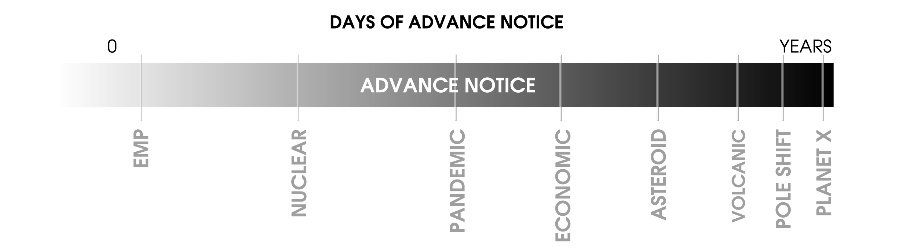
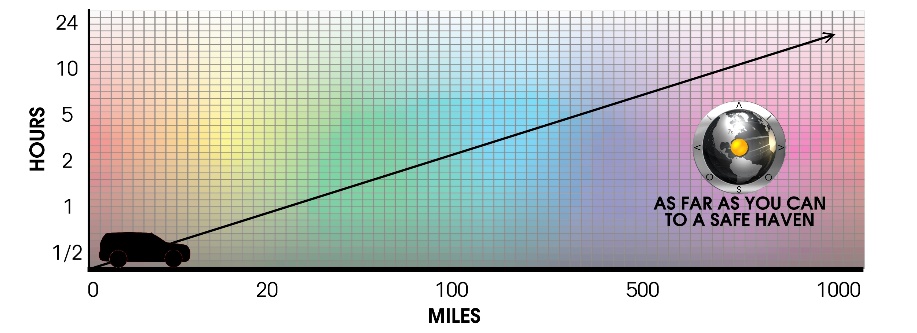
Now let’s consider the time and distance fallacy of how long and far you can travel. With virtually all of the above event timelines, you will have sufficient notice to hit the road and bug out. Even an EMP won’t stop you if you are prepared, with a stand-by supply of fuel storage in 5-gallon containers, food, blankets, and your bug-out bag. Most experts don’t believe an EMP will affect a vehicle, since it is fully grounded and shielded. But, if you are extra cautious, buy and have the spare computer boards/modules necessary for your vehicle to start, run, and drive, stored in a Faraday bag in your trunk. No fuel, no worries; carry a siphon to extract fuel from abandoned vehicles, equipment, and even underground storage tanks.
In 24 hours, you can get virtually anywhere, if you are prepared and stop believing that you won’t be able to make it safely. That said, it is better to leave too early, than too late!
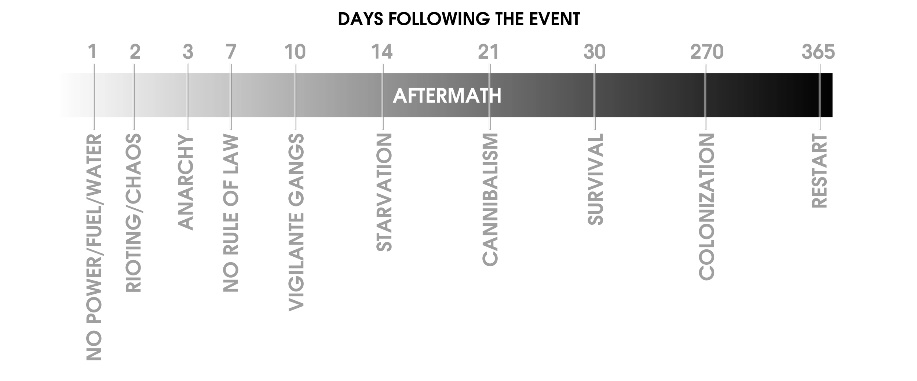
Here’s what you can expect, following virtually every catastrophic event. The only way to survive each phase is to be far away from the metro hell zones that were not prepared and with people that will become the victims of each other.
So, how far are you willing to drive to get to your safe haven, before, during or after one of these epic events?
Vivos has shelters completed and in development in strategic locations across America and around the world. Each site is considered a safer zone than most others, providing the best chances of survival from virtually all of the predicted events. A backyard shelter in a metropolitan area may survive the event but will unlikely survive the aftermath events that follow.
Survival starts with a survivable location – high, dry, and far away from all known targets and metro areas. Then, a worthy concrete and steel constructed shelter that is built to withstand the forces and effects of virtually all threats is a must if you expect to survive. Corrugated repurposed pipes, steel boxes or shipping containers are not structurally able to withstand the anticipated forces and will likely collapse from the event itself. Next, you need an ample supply of food, water, fuel, medicines, clothing, air filtration, and security to ride out an event – weeks, months and even years. But, at the end of the day, it also takes a group of like-minded individuals, equally prepared, ready, willing, and able to defend your shelter community from all others. You need these people to have your back and provide their expert services in exchange for yours.
Vivos’ shelter communities provide you and your family the ultimate life-assurance solution at a relatively affordable cost. Our Vivos xPoint complex in South Dakota has 575 bunkers, each able to accommodate up to 24 people (a very large family) for as little as $55,000. That’s roughly $2,000 per person! You can outfit your bunker to your standards and budget from as low as $12,000 for a basic Glamping survivability condition or go for the extreme and build out your bunker like a high-end home.
Now that we’ve debunked the Time – Distance Fallacy, where do you want to be (bug out to) when all hell breaks loose and the proverbial SHTF?
An Epic Humanitarian Survival Project
Robert K. Vicino
Founder & CEO
The Vivos Group
rvicino@terravivos.com
http://www.terravivos.com
Vivos is featured on thousands of broadcasts. Everyone wants to know why & how people are preparing.


Don’t wait for disaster to strike. Join the Vivos network or own a private shelter and be prepared for whatever comes next.