Modern emergency preparedness is increasingly moving beyond individual emergency kits, short-term supplies, and household plans.
Cities and communities are paying greater attention to infrastructure that can protect and support large numbers of people when normal systems are disrupted.
One example is the growing attention being given to underground civil-defense shelters in Europe.
In Finland, extensive underground shelter infrastructure has long been incorporated into national preparedness planning. In 2026, Finnish authorities continued strengthening shelter planning, maintenance, and emergency exercises, while cities such as Helsinki and Kuopio demonstrated how large underground spaces can serve both everyday and emergency purposes.
This raises an important question:
Could community-scale underground shelters become a larger part of modern resilience planning?
For communities preparing for prolonged emergencies, the answer is increasingly reflected in the way protected infrastructure is being designed, maintained, and integrated into broader preparedness strategies.
From Emergency Shelters to Community Resilience
Traditional emergency preparedness often focuses on what individuals can do.
Families may store food and water, purchase backup power equipment, create emergency plans, and keep basic medical supplies available.
These measures remain important.
But major emergencies can affect entire communities at once.
Power grids can become unavailable. Water systems can be disrupted. Communications may fail. Transportation networks can be interrupted. Supply chains can become unreliable.
When several systems are affected simultaneously, individual preparation can become more difficult.
This is where community-scale shelters offer a different approach.
Instead of relying entirely on individual households, a large shelter can bring people together around shared infrastructure, resources, equipment, and responsibilities.
That community model is becoming increasingly relevant to discussions about long-term resilience.
What Finland Demonstrates About Community-Scale Sheltering
Finland provides one of the clearest examples of how underground shelters can become part of a country’s broader preparedness system.
The country has more than 50,000 civil-defense shelters, with many located beneath residential and commercial buildings. Helsinki alone has extensive underground infrastructure, including large facilities that serve everyday purposes but can be converted for emergency sheltering.
One example is Helsinki’s Merihaka shelter.
The facility covers approximately 71,000 cubic meters and can accommodate around 6,000 people. During normal conditions, parts of the underground facility are used for recreational activities. In an emergency, it can be converted into a functioning shelter with equipment such as bunk beds, water tanks, and portable toilets.
This illustrates an important principle:
A community shelter does not have to exist separately from everyday life.
With appropriate planning, large protected spaces can serve practical purposes during normal conditions while remaining available for emergency use.
Resilience Requires More Than a Strong Structure
A shelter is more than walls, doors, and underground space.
For a facility intended to support people during an extended disruption, multiple systems have to work together.
These can include:
- Power generation and backup power
- Water storage and treatment
- Air filtration and ventilation
- Food storage and preparation
- Communications
- Medical resources
- Sanitation
- Security
- Emergency access
- Sleeping and living areas
- Common spaces
- Resource management
This is one of the most important differences between simply having an underground space and having a functioning survival community.
The objective is not only to provide physical protection.
It is to create an environment where people can continue meeting essential needs when normal infrastructure is unavailable.
Modern Shelter Planning Is Increasingly Focused on Readiness
Another important development is that governments are paying attention not only to building shelters, but also to maintaining and preparing them.
In January 2026, Finland’s Ministry of the Interior published new guidance covering the planning, activation, use, and maintenance of civil-defense shelters. The guidance emphasizes that shelters need to remain operational and that emergency planning should take place before a crisis occurs.
This is an important lesson for long-term preparedness.
A shelter is only useful if people understand:
- How it will be activated
- Who is responsible for operating it
- How people will access it
- How essential systems will function
- What resources are available
- How the community will organize during an emergency
Preparedness therefore becomes an ongoing process rather than a one-time purchase or construction project.
Large-Scale Exercises Test More Than Infrastructure
Modern resilience planning also increasingly involves exercises that bring authorities, organizations, businesses, and residents together.
In September 2026, Finland held the Shelter 2026 civil-defense exercise in Kuopio. More than 2,000 participants took part in an exercise designed to test how large numbers of people could be protected during disruptions and emergency conditions. The exercise also focused on communications, coordination, decision-making, and cooperation between different organizations.
This demonstrates another important aspect of community resilience:
Infrastructure and people have to work together.
A large shelter may have sophisticated systems, but those systems still require people who understand how to operate, maintain, and manage them.
A resilient community therefore depends on both infrastructure and human capability.
Why Shared Infrastructure Matters
One reason community shelters can be attractive for long-term preparedness is the ability to share infrastructure.
A single household would have difficulty independently maintaining every system needed for prolonged sheltering.
A community can divide responsibilities and resources across a larger group.
For example, different members may contribute knowledge in areas such as:
- Medicine
- Engineering
- Electrical systems
- Mechanical maintenance
- Agriculture
- Food preparation
- Communications
- Security
- Construction
- Education
- Administration
The result is more than a collection of individual shelter spaces.
It becomes a community with shared capabilities.
Terra Vivos describes this community-based approach as combining shared infrastructure, resources, security, diverse skills, and long-term preparedness.
Underground Shelters Can Support Different Types of Communities
Not every underground shelter follows the same model.
Some are government-operated civil-defense shelters designed to protect local populations.
Others may be dual-use facilities that function as recreational, commercial, or community spaces during normal conditions and can be converted during emergencies.
There are also privately developed survival communities designed specifically around long-term preparedness.
The common principle is the use of protected infrastructure to support people at a scale larger than a single household.
That distinction is important when discussing modern underground shelter planning.
Terra Vivos is not a government civil-defense system like Finland’s national shelter network. Instead, it represents a private community-based model of long-term survival preparedness.
The Terra Vivos Community-Shelter Model
Terra Vivos focuses on large-scale underground survival communities where members can share protected infrastructure and resources.
Its projects demonstrate several different approaches to community-scale sheltering.
Vivos xPoint
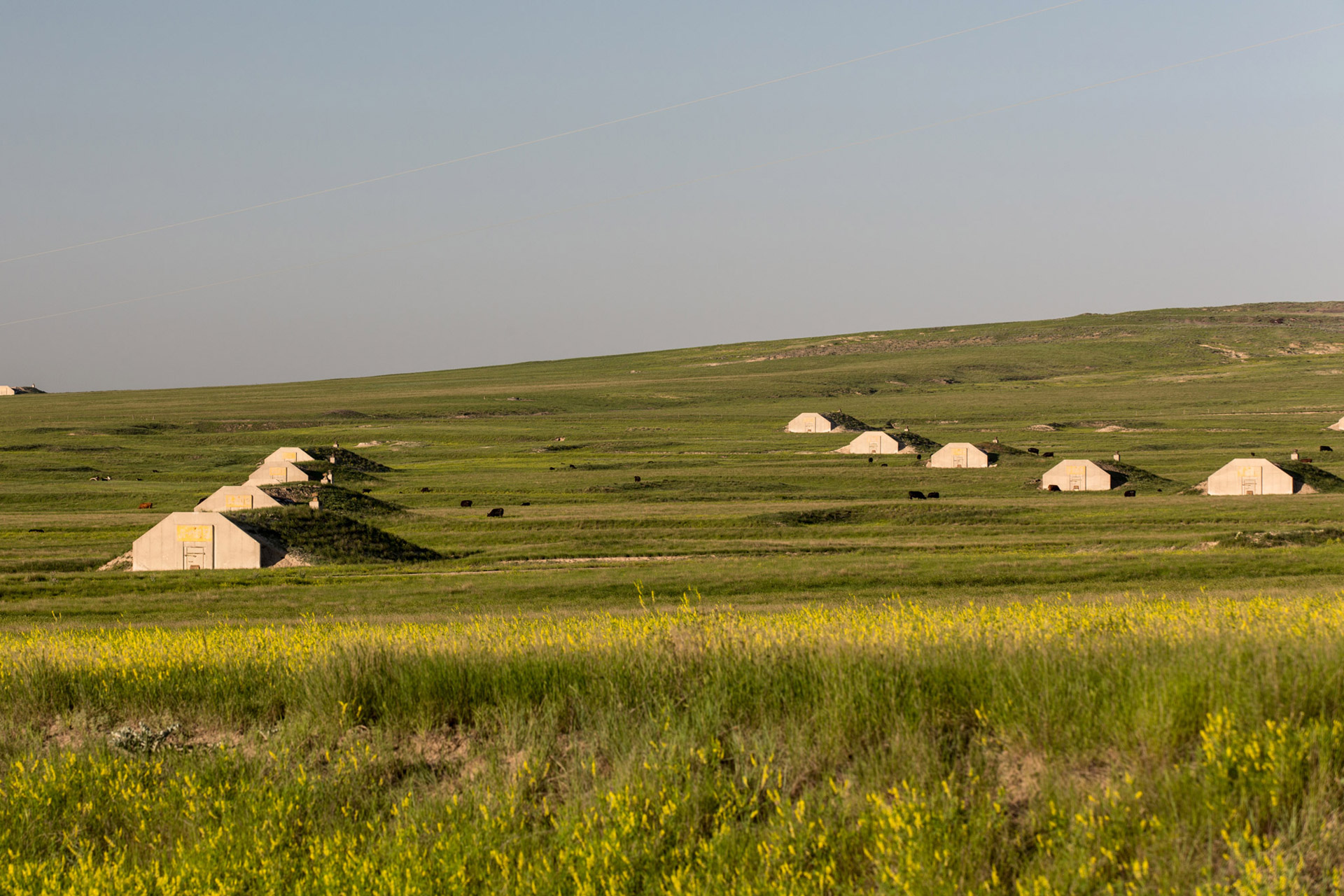
Vivos xPoint is located near the Black Hills in South Dakota and consists of 575 hardened military-built bunkers developed into a large survival community.
The site was originally constructed as a U.S. Army munitions facility and later repurposed by Vivos. The community provides accommodations for thousands of people across the former military complex.
Vivos Europa One
Vivos Europa One represents another large-scale approach.
The underground complex is located within a former military facility in Germany and was designed around extensive protected living and community areas.
The facility illustrates how large existing underground structures can provide a foundation for community-scale preparedness.
Vivos Trine
Vivos Trine is designed for larger groups, providing another model for people who want to approach preparedness collectively rather than through an individual household bunker.
Vivos Indiana
Vivos Indiana provides another community-based shelter option, designed around shared preparedness and protected living space.
Together, these projects reflect Terra Vivos’ broader focus on underground survival communities rather than simply selling isolated emergency spaces.
Why Community Scale Can Matter During Long-Term Emergencies
The longer an emergency lasts, the more important organization becomes.
A short disruption may require little more than temporary shelter and emergency supplies.
A prolonged disruption can create very different requirements.
People may need:
- Reliable water
- Food management
- Power
- Sanitation
- Medical support
- Communications
- Maintenance
- Security
- Education
- Recreation
- Social cooperation
These requirements become difficult for one household to manage independently.
A community environment allows responsibilities and resources to be distributed among multiple people.
That does not eliminate the challenges of an emergency.
Instead, it provides a framework for addressing those challenges collectively.
The Future of Resilience Planning May Be More Community-Oriented
Recent developments in Finland and elsewhere suggest that emergency sheltering is being considered as part of broader resilience planning rather than as an isolated response to a single type of disaster.
The focus is increasingly on:
Infrastructure + preparedness + people + coordination.
Finland’s shelter system demonstrates how underground facilities can be incorporated into national and local preparedness.
Large civil-defense exercises demonstrate the importance of practicing how those facilities will actually be used.
And private survival communities demonstrate another model: creating dedicated environments where people can prepare collectively for prolonged disruptions.
These approaches are different, but they share a common principle.
Resilience is stronger when people have infrastructure and a plan before they need it.
Underground Community Shelters and Long-Term Preparedness
For people thinking beyond short-term emergency supplies, an underground community shelter can provide a different preparedness model.
Instead of asking only:
“What supplies can my family store?”
The question becomes:
“What infrastructure, resources, skills, and community support would be available if normal systems were disrupted for an extended period?”
That shift is significant.
It moves preparedness from an individual checklist toward a broader community strategy.
Terra Vivos’ survival shelters are designed around this broader concept, combining protected environments with shared resources and community-based preparedness.
What Modern Community Shelter Planning Can Teach Us
Several lessons stand out from the growing attention to large-scale underground shelters.
1. Preparedness needs to happen before a crisis
Shelters, equipment, emergency plans, and responsibilities cannot be developed effectively at the last moment.
2. Infrastructure needs ongoing maintenance
A shelter must remain ready to function when it is needed.
3. People are part of the infrastructure
Engineers, medical professionals, technicians, administrators, and other skilled individuals can all contribute to community resilience.
4. Shared resources can support long-term preparedness
Power, water, communications, food systems, and other infrastructure can be organized collectively.
5. Community coordination matters
A functioning shelter requires rules, responsibilities, communication, and cooperation.
6. Resilience is about more than one threat
Modern preparedness considers a range of possible disruptions rather than focusing exclusively on a single scenario.
Final Thoughts
Underground community shelters are becoming an increasingly visible part of modern resilience planning.
Finland provides a real-world example of how large underground shelters can be integrated into national preparedness, maintained over time, and tested through large-scale exercises.
Private survival communities represent a different approach, focused on giving members access to protected infrastructure, shared resources, and community-based preparedness.
For Terra Vivos, this community-scale philosophy is central to its model.
The future of preparedness may not simply be about having a shelter.
It may be about having a place, infrastructure, resources, skills, and a community prepared to use them together.
Frequently Asked Questions
What is a community survival shelter?
A community survival shelter is a protected facility designed to accommodate multiple people or families while providing shared infrastructure, resources, and systems for emergency preparedness.
Why are underground shelters becoming part of resilience planning?
Underground shelters can provide protected environments for large groups and can incorporate systems such as power, water, ventilation, communications, and emergency facilities. Countries such as Finland have integrated large-scale shelters into broader civil-defense planning.
What can a community shelter provide during a prolonged emergency?
Depending on the facility, community shelters can provide protected living areas, backup power, water resources, air-management systems, food storage, communications, security, medical resources, and shared spaces.
How is a community shelter different from a private bunker?
A private bunker generally focuses on an individual household or small group, while a community shelter is designed around shared infrastructure, resources, responsibilities, and multiple occupants.
What does Finland’s shelter system teach about community resilience?
Finland demonstrates the importance of maintaining shelters before they are needed, planning how they will be activated, training people to use them, and integrating shelter infrastructure into wider emergency preparedness.
Does Terra Vivos provide community survival shelters?
Yes. Terra Vivos develops several large-scale survival communities, including Vivos xPoint, Vivos Europa One, Vivos Trine, and Vivos Indiana, offering different approaches to community-based preparedness.
Why is community-based preparedness important?
Long-term emergencies can affect power, water, communications, transportation, healthcare, and supply chains simultaneously. A community approach allows infrastructure, resources, responsibilities, and skills to be shared rather than relying entirely on one household.


