In recent years, interest in underground shelters has grown rapidly as global uncertainty continues to rise. Concerns over war, cyber attacks, EMP threats, economic instability, pandemics, and natural disasters have caused more individuals and families to think seriously about long-term preparedness.
But when people begin researching survival shelters, one major question quickly emerges:
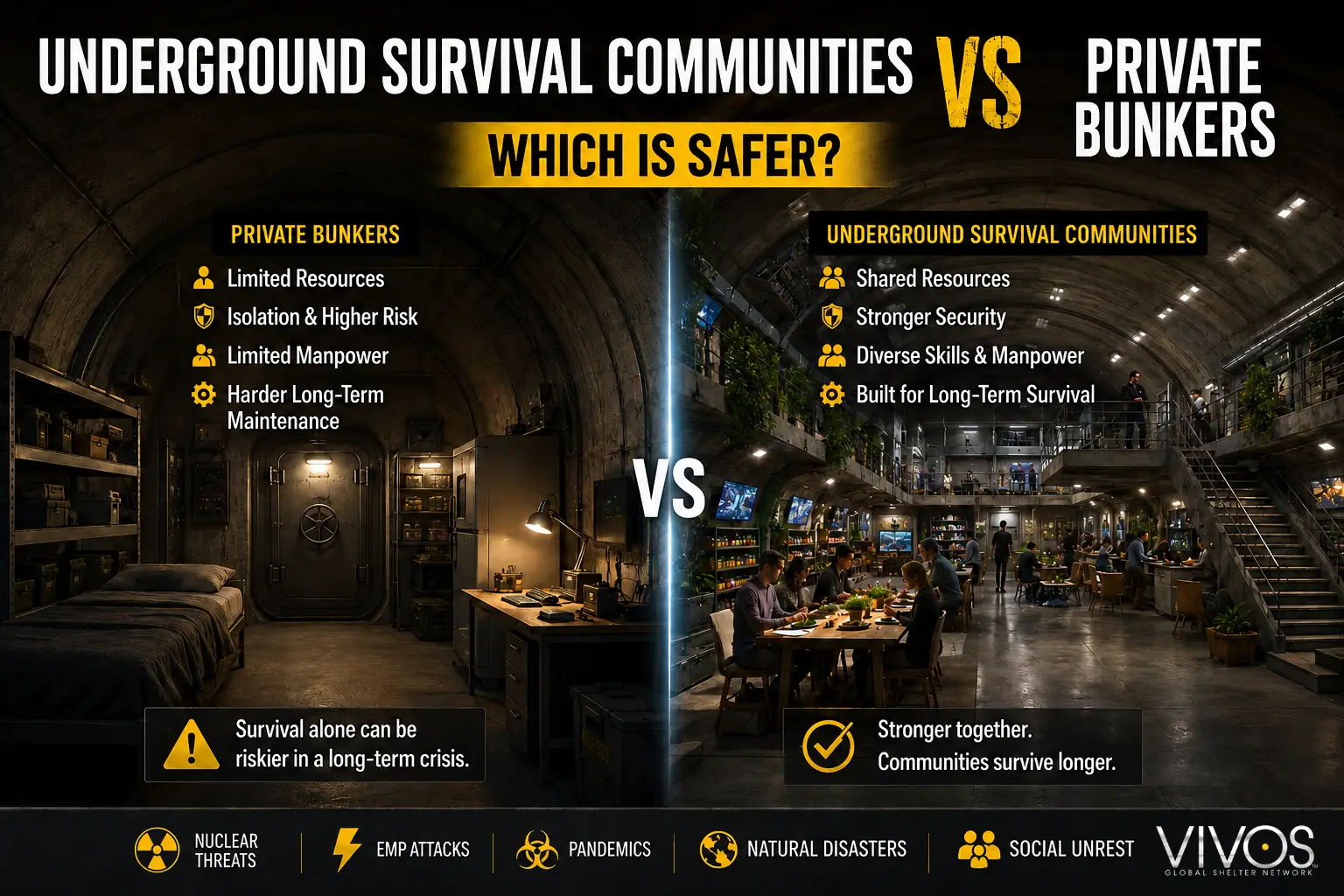
Is it safer to survive alone in a private bunker—or inside a larger underground survival community?
While private bunkers may seem appealing for independence and privacy, survival experts increasingly point toward community-based underground shelters as the more sustainable long-term solution.
In this guide, we’ll compare both approaches, examine their strengths and weaknesses, and explore why large-scale underground survival communities are gaining global attention.
Why Preparedness Is Becoming More Important
Modern society depends on interconnected systems:
- Power grids
- Food supply chains
- Fuel transportation
- Communication networks
- Banking systems
If these systems experience prolonged disruption, daily life can change rapidly.
Recent global events have already shown how quickly shortages, panic buying, infrastructure stress, and social instability can emerge during crises.
That’s why more people are exploring:
- Underground bunkers
- Off-grid living systems
- Long-term survival shelters
- Community preparedness solutions
What Is a Private Survival Bunker?
A private bunker is typically a small underground shelter owned by an individual or family. These shelters are often built:
- In backyards
- Under homes
- On remote private land
Most private bunkers are designed to provide short-term protection from:
- Severe weather
- Civil unrest
- Fallout exposure
- Supply shortages
Some are highly advanced and include:
- Air filtration systems
- Backup generators
- Security solutions
However, surviving long-term in complete isolation presents major challenges.
The Advantages of Private Bunkers
1. Privacy & Control
Private shelters allow owners to control every aspect of their environment, including:
- Supplies
- Security
- Access
- Daily operations
For some people, this independence is appealing.
2. Immediate Accessibility
A home bunker may be easier to access quickly during sudden emergencies.
3. Custom Design
Owners can personalize layouts, systems, and storage based on their preferences.
The Biggest Weaknesses of Private Bunkers
While private bunkers offer independence, they also come with significant risks.
1. Limited Long-Term Sustainability
Most small bunkers struggle with:
- Long-term power generation
- Water purification
- Medical capabilities
- Maintenance systems
Over time, even small failures can become life-threatening.
2. Isolation Creates Vulnerability
Survival is rarely just about supplies.
Long-term crises often require:
- Medical knowledge
- Security teams
- Engineering skills
- Communication systems
- Psychological stability
One family alone may not have all the skills necessary to survive extended disruptions.
3. Security Risks Increase During Social Collapse
In major emergencies, isolated shelters can become targets.
If social order breaks down, defending a small private bunker against desperate groups becomes extremely difficult.
This is one reason many preparedness experts believe isolated backyard bunkers are not ideal for large-scale disasters.
You can read more about the risks of residential shelters here:
Why Backyard Shelters Often Fail During Crisis
What Is an Underground Survival Community?
An underground survival community is a large-scale shelter system designed for groups rather than isolated individuals.
Instead of focusing only on survival, these communities are designed around:
- Long-term sustainability
- Shared resources
- Security infrastructure
- Community resilience
Some modern underground communities include:
- Independent power systems
- Water wells
- Medical facilities
- Food storage
- Communication systems
- Air filtration
- Security teams
- Living quarters for large groups
Why Community-Based Survival Is Gaining Attention
Many experts believe community-based preparedness dramatically improves long-term survival odds.
Why?
Because no single person can master every survival skill.
Communities allow residents to share expertise in:
- Medicine
- Engineering
- Agriculture
- Security
- Communications
- Maintenance
This creates a much more resilient survival environment.
The Advantages of Underground Survival Communities
1. Stronger Security
Larger underground shelter communities are often built with:
- Reinforced structures
- Controlled access points
- Security systems
- Perimeter protection
This reduces vulnerability during widespread instability.
2. Long-Term Infrastructure
Unlike smaller private shelters, community-based facilities can support:
- Larger fuel reserves
- Water purification systems
- Backup power systems
- Food storage for extended periods
This makes long-duration survival far more realistic.
3. Shared Skills & Human Resources
Communities benefit from having members with diverse expertise.
In prolonged emergencies, this becomes incredibly valuable.
4. Better Psychological Stability
Isolation during crises can create intense mental stress.
Living within a structured community environment provides:
- Social interaction
- Shared responsibilities
- Emotional support
- Improved morale
Terra Vivos and the Rise of Modern Survival Communities
One of the most recognized names in large-scale underground preparedness is Terra Vivos.
Unlike traditional bunker companies focused only on individual shelters, Terra Vivos focuses heavily on community-based survival infrastructure.
Its shelter systems are designed around:
- Long-term survivability
- Hardened underground protection
- Group sustainability
- Security and resilience
Some of the most well-known projects include:
These facilities are designed to withstand multiple global threats, including:
- EMP events
- Nuclear fallout
- Extreme weather
- Civil unrest
- Supply chain collapse
Which Option Is Actually Safer?
The answer depends on the scale of the crisis.
For short-term emergencies:
- A private bunker may provide temporary protection.
For long-term societal disruption:
- Community-based underground shelters generally offer greater resilience and sustainability.
The reality is that survival involves much more than simply hiding underground.
It requires:
- Infrastructure
- Security
- Skills
- Sustainability
- Human cooperation
The Importance of Planning Before a Crisis
One of the biggest mistakes people make is assuming they can prepare after a crisis begins.
In reality:
- Supplies disappear quickly
- Roads become congested
- Panic spreads rapidly
- Infrastructure becomes unreliable
Preparedness is most effective when planned early.
Final Thoughts
The world is becoming increasingly unpredictable.
From geopolitical instability to infrastructure risks, more people are recognizing the importance of long-term preparedness.
While private bunkers offer independence, underground survival communities provide something far more valuable:
Long-term resilience.
Because in a prolonged crisis, survival is not just about protection—
It’s about maintaining a functioning, sustainable community.
Learn More About Underground Survival Communities
Explore available shelter systems and preparedness solutions at:
Call: 619-252-8311
FAQs
1. Are underground survival communities safer than private bunkers?
For long-term crises, many experts believe community-based shelters provide stronger security, sustainability, and survival capabilities.
2. What are the biggest weaknesses of private bunkers?
Limited infrastructure, isolation, and security vulnerabilities are among the biggest challenges.
3. What makes underground survival communities different?
They combine shared resources, long-term systems, medical support, and security infrastructure into one survival network.
4. What is Terra Vivos?
Terra Vivos is a company focused on large-scale underground survival shelters and community-based preparedness solutions.
5. Can underground shelters protect against EMP or nuclear threats?
Some hardened underground shelters are specifically engineered to help protect occupants from EMP events, fallout, and extreme disasters.
6. Is preparedness only for extreme scenarios?
No. Preparedness is useful for power outages, supply disruptions, natural disasters, and large-scale emergencies alike.


