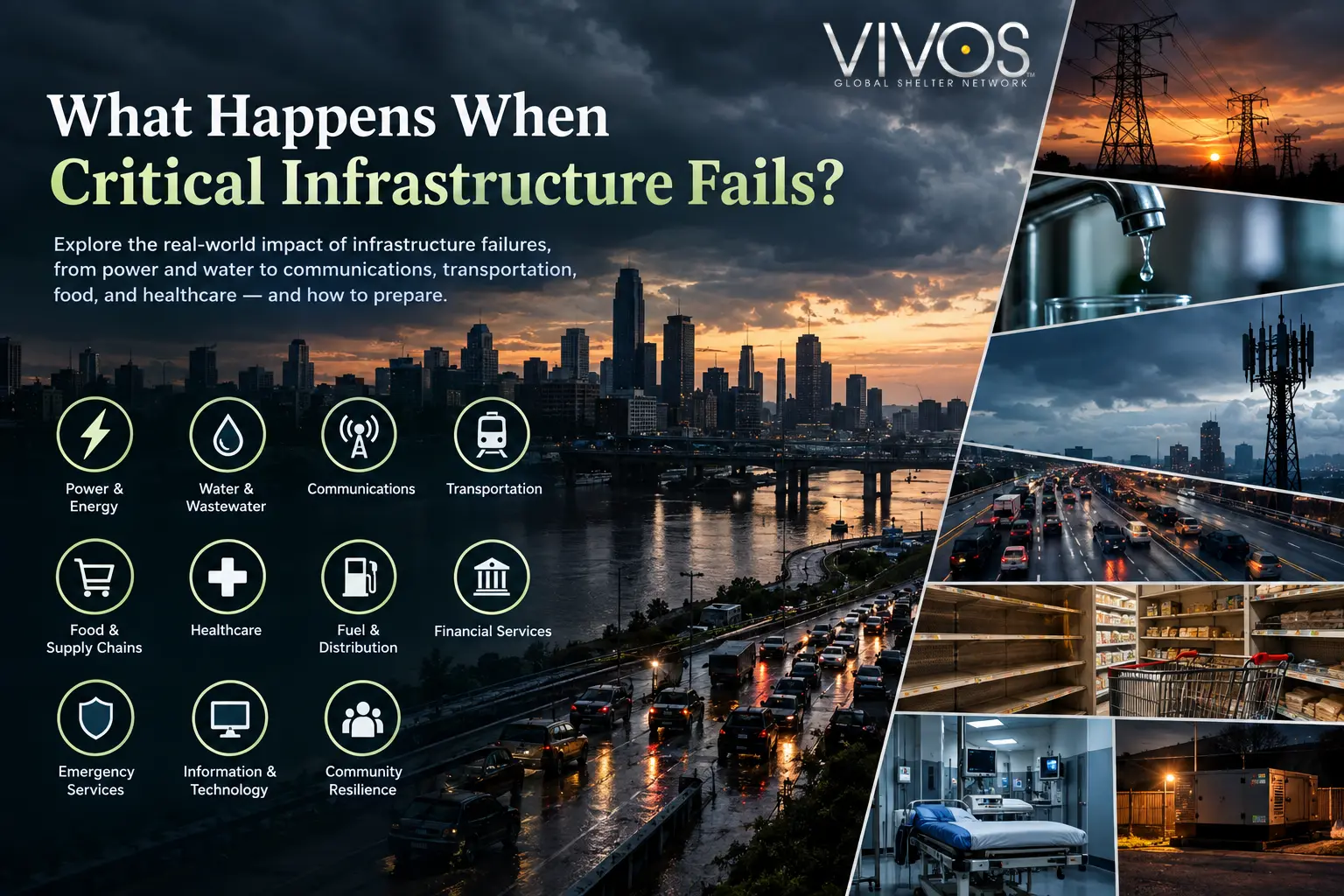
Modern life depends on systems that most people rarely think about until something goes wrong.
Electricity powers homes, businesses, hospitals, communication networks, water systems, and transportation. Roads and fuel networks move people and supplies. Telecommunications connect communities, while supply chains keep food, medicine, and other essential goods available.
When one of these systems experiences a major disruption, the effects can extend far beyond the original problem. When several systems are affected at the same time, communities can face increasingly difficult challenges.
For people thinking about long-term emergency preparedness, understanding what happens when critical infrastructure fails is an important part of planning.
What Is Critical Infrastructure?
Critical infrastructure refers to the essential systems and services that allow communities and economies to function.
These can include:
- Electricity and energy systems
- Water and wastewater systems
- Telecommunications
- Transportation networks
- Healthcare facilities
- Food and supply chains
- Fuel distribution
- Financial services
- Emergency services
- Information and communication systems
These systems are interconnected.
A disruption in one area can create problems in another. For example, a prolonged power outage can affect water treatment, telecommunications, fuel stations, refrigeration, hospitals, and businesses.
This interconnectedness is why infrastructure resilience matters during major emergencies.
What Happens When the Power Goes Out?
Electricity is one of the most important components of modern infrastructure.
A short power outage may be inconvenient. A prolonged outage can create much larger challenges.
Depending on the circumstances, an extended loss of electricity could affect:
- Lighting
- Heating and cooling
- Refrigeration
- Water pumps
- Internet access
- Mobile communications
- Medical equipment
- Transportation systems
- Businesses and workplaces
Backup generators and battery systems can provide temporary support, but their effectiveness depends on available fuel, equipment capacity, maintenance, and the duration of the outage.
For households preparing for longer disruptions, having a plan for power is therefore an important consideration.
What Happens to Water Systems?
Most people expect clean water to remain available whenever they turn on a faucet.
However, water systems depend on infrastructure that can require electricity, treatment facilities, pumping stations, pipelines, personnel, and transportation.
A major infrastructure disruption could affect:
- Water treatment
- Pumping
- Distribution
- Wastewater systems
- Water pressure
- Access to drinking water
If public water service becomes unavailable or unsafe, households may need stored water and appropriate purification methods.
For longer emergencies, water management becomes a much larger challenge than simply keeping a few bottles at home.
How Could Telecommunications Be Affected?
Communication becomes especially important during emergencies.
People need reliable ways to:
- Contact family members
- Receive emergency information
- Coordinate transportation
- Access news and updates
- Contact medical or emergency services
- Communicate with other community members
Telecommunications infrastructure can depend on electricity, network equipment, physical infrastructure, and functioning data networks.
Backup power can help maintain certain systems, but widespread or prolonged disruptions can still affect communication capabilities.
This is why emergency planning should include more than a single communication method.
What Happens to Transportation?
Transportation connects people with food, fuel, medical care, workplaces, and other essential services.
A major disruption could affect:
- Roads and bridges
- Public transportation
- Airports
- Fuel stations
- Freight networks
- Delivery services
- Emergency transportation
Transportation problems can also create secondary effects.
If trucks cannot operate normally, stores may receive fewer deliveries. If fuel distribution is disrupted, transportation and backup generators may also be affected.
This demonstrates how infrastructure systems can depend on one another.
What Happens to Food Supply Chains?
Modern food distribution relies on a complex network of farms, manufacturers, warehouses, trucks, retailers, refrigeration systems, fuel, electricity, and communications.
A disruption at any stage can create delays.
Potential effects can include:
- Reduced store inventories
- Delivery delays
- Refrigeration problems
- Higher demand for available supplies
- Difficulty transporting food
- Increased pressure on local resources
Short disruptions may be manageable as systems recover.
Longer disruptions require a different level of preparation, particularly for households or communities with limited access to alternative food sources.
This is one reason long-term preparedness involves more than simply purchasing emergency supplies.
How Could Healthcare Be Affected?
Healthcare systems rely on nearly every other major infrastructure system.
Hospitals and medical facilities require:
- Electricity
- Water
- Communications
- Medical supplies
- Transportation
- Fuel
- Trained personnel
- Refrigeration and climate control
Emergency departments may also experience increased demand during major disasters.
Healthcare facilities typically have emergency plans and backup systems, but the scale and duration of an infrastructure failure can influence how effectively those systems operate.
For individuals with ongoing medical needs, emergency planning should include medications, essential medical equipment, and communication with healthcare providers where possible.
What Happens When Multiple Systems Fail?
The most significant challenge can occur when infrastructure failures happen simultaneously or create a chain reaction.
Consider a simplified example:
Power failure
↓
Water pumps and treatment systems are affected
↓
Communication systems experience disruptions
↓
Fuel stations have difficulty operating
↓
Transportation becomes more difficult
↓
Deliveries are delayed
↓
Food and essential supplies become harder to access
The exact sequence would depend on the event, location, infrastructure, backup systems, and response capabilities.
The important lesson is that critical infrastructure is interconnected.
Preparing for one isolated failure can therefore be different from preparing for a prolonged disruption affecting multiple systems.
How Long Could an Infrastructure Disruption Last?
There is no single answer.
Some infrastructure failures can be resolved relatively quickly, while major disasters can create disruptions lasting days, weeks, or potentially longer in affected areas.
Duration depends on factors such as:
- Cause of the disruption
- Geographic scale
- Damage to infrastructure
- Availability of replacement equipment
- Access to fuel and supplies
- Weather conditions
- Transportation
- Workforce availability
- Emergency response capabilities
This uncertainty is one reason preparedness plans should account for different timeframes rather than assuming that every emergency will be resolved within a few hours.
How Can Households Prepare?
Household preparedness can reduce dependence on external systems during temporary disruptions.
Important considerations include:
Food
Maintain an appropriate supply of shelf-stable food and know how it will be prepared if normal cooking methods are unavailable.
Water
Store drinking water and understand appropriate purification methods.
Power
Consider backup power options for essential devices and understand their operating limitations.
Communications
Maintain multiple ways to receive emergency information and communicate with family members.
Medical Supplies
Keep essential medications, first-aid supplies, and other necessary medical items available.
Lighting
Have reliable emergency lighting and spare batteries or alternative power sources.
Sanitation
Plan for hygiene and waste management if normal water and sewage services become unavailable.
Emergency Information
Keep important contact information, documents, and emergency instructions accessible offline.
Household preparedness is particularly useful for short-term and localized disruptions.
What About Long-Term Infrastructure Failures?
The longer an infrastructure disruption continues, the more difficult it can become to rely entirely on normal public systems.
After several days, people may need to think beyond immediate emergency supplies.
Longer-term considerations can include:
- Reliable shelter
- Water security
- Food management
- Power generation
- Air quality
- Medical support
- Communications
- Security
- Sanitation
- Community cooperation
This is where long-term preparedness becomes different from preparing for a conventional short-term emergency.
For more information, see How Underground Survival Communities Prepare for Long-Term Emergencies.
How Underground Shelters Can Support Infrastructure Resilience
Underground survival shelters are designed around a different preparedness model.
Rather than relying entirely on normal public infrastructure, some facilities incorporate systems intended to support essential functions within the shelter itself.
Depending on the facility, these may include:
- Backup or independent power
- Water storage and treatment
- Air filtration
- Food storage
- Communications
- Secure entrances
- Living facilities
- Shared community resources
The specific capabilities vary between shelters, so prospective members should evaluate the documented infrastructure of each facility carefully.
The goal is not to suggest that an underground shelter is independent of every external system. Instead, the objective is to create additional preparedness options when some normal infrastructure may be unavailable.
Why Community Preparedness Matters
Infrastructure failures don’t only create technical problems.
They can affect people.
During a prolonged disruption, communities may need individuals with different skills, including:
- Medical professionals
- Engineers
- Electricians
- Mechanics
- Technicians
- Food specialists
- Communications specialists
- Security personnel
- Maintenance professionals
A community-based shelter can bring together people with different knowledge and experience while allowing certain infrastructure and responsibilities to be shared.
This is one of the central ideas behind underground survival communities.
How Terra Vivos Approaches Long-Term Preparedness
Terra Vivos develops large-scale underground survival communities designed around protection, infrastructure, preparedness, and community resilience.
Its projects include:
Vivos xPoint
Vivos xPoint is located near Edgemont, South Dakota, and includes hundreds of hardened military-built bunkers developed into an underground survival community.
Vivos Europa One
Vivos Europa One is located within a former Cold War military facility in Germany and is designed as a large-scale underground survival complex.
Vivos Indiana
Vivos Indiana is another Terra Vivos community-based shelter designed around long-term preparedness.
Each facility has different characteristics, infrastructure, and requirements. Prospective members should review the specific details of the shelter they are considering.
Preparing for an Infrastructure Failure
No one can predict exactly when a major infrastructure disruption will occur or how long it will last.
What individuals and families can do is prepare for different levels of disruption.
Start with the basics:
Food → Water → Power → Communications → Medical → Sanitation → Shelter
Then consider what changes if the disruption lasts for:
- 24 hours
- 72 hours
- One week
- Several weeks
- Several months
The longer the potential disruption, the more important infrastructure, resource management, and community support become.
Final Thoughts
Critical infrastructure is easy to take for granted because modern systems normally operate continuously.
But electricity, water, communications, transportation, healthcare, fuel, and food distribution are interconnected. A major disruption to one system can create challenges for others, particularly when the disruption continues for an extended period.
Preparedness is not about predicting exactly what will happen.
It is about understanding dependencies, identifying vulnerabilities, and creating additional options before they are needed.
For those planning beyond short-term emergencies, underground survival communities offer one approach that combines protected shelter, infrastructure, shared resources, and community preparedness in a single environment.
Explore Terra Vivos
Learn more about Terra Vivos underground survival communities and available shelter options:
- Vivos xPoint
- Vivos Europa One
- Vivos Indiana
- Available Shelters
- Membership Application
- Contact Terra Vivos
Frequently Asked Questions
What is critical infrastructure?
Critical infrastructure includes essential systems and services such as electricity, water, transportation, telecommunications, healthcare, fuel, and food distribution that support everyday community functioning.
What happens if critical infrastructure fails?
The effects depend on the type, scale, and duration of the failure. A major disruption can affect electricity, water, communications, transportation, healthcare, food distribution, and other connected services.
How does a power outage affect other infrastructure?
Electricity supports many essential systems, including water pumps, communications equipment, refrigeration, transportation infrastructure, and medical facilities. A prolonged outage can therefore create secondary disruptions.
How long can critical infrastructure remain disrupted?
There is no universal timeframe. Recovery depends on the cause, geographic scale, infrastructure damage, available resources, weather, transportation, and emergency response capabilities.
How can families prepare for infrastructure failures?
Families can prepare by maintaining supplies of food and water, backup power, emergency lighting, medical necessities, communication options, and sanitation resources, while also having a plan for different disruption durations.
Can underground shelters operate without public infrastructure?
Capabilities vary by facility. Some underground shelters incorporate backup or independent systems for power, water, air management, communications, and other essential functions. Prospective members should review the specific capabilities and limitations of each facility.
Why is community preparedness important?
Long-term disruptions can require a wide range of skills and resources. A community can bring together people with different expertise while sharing certain infrastructure, responsibilities, and resources.


