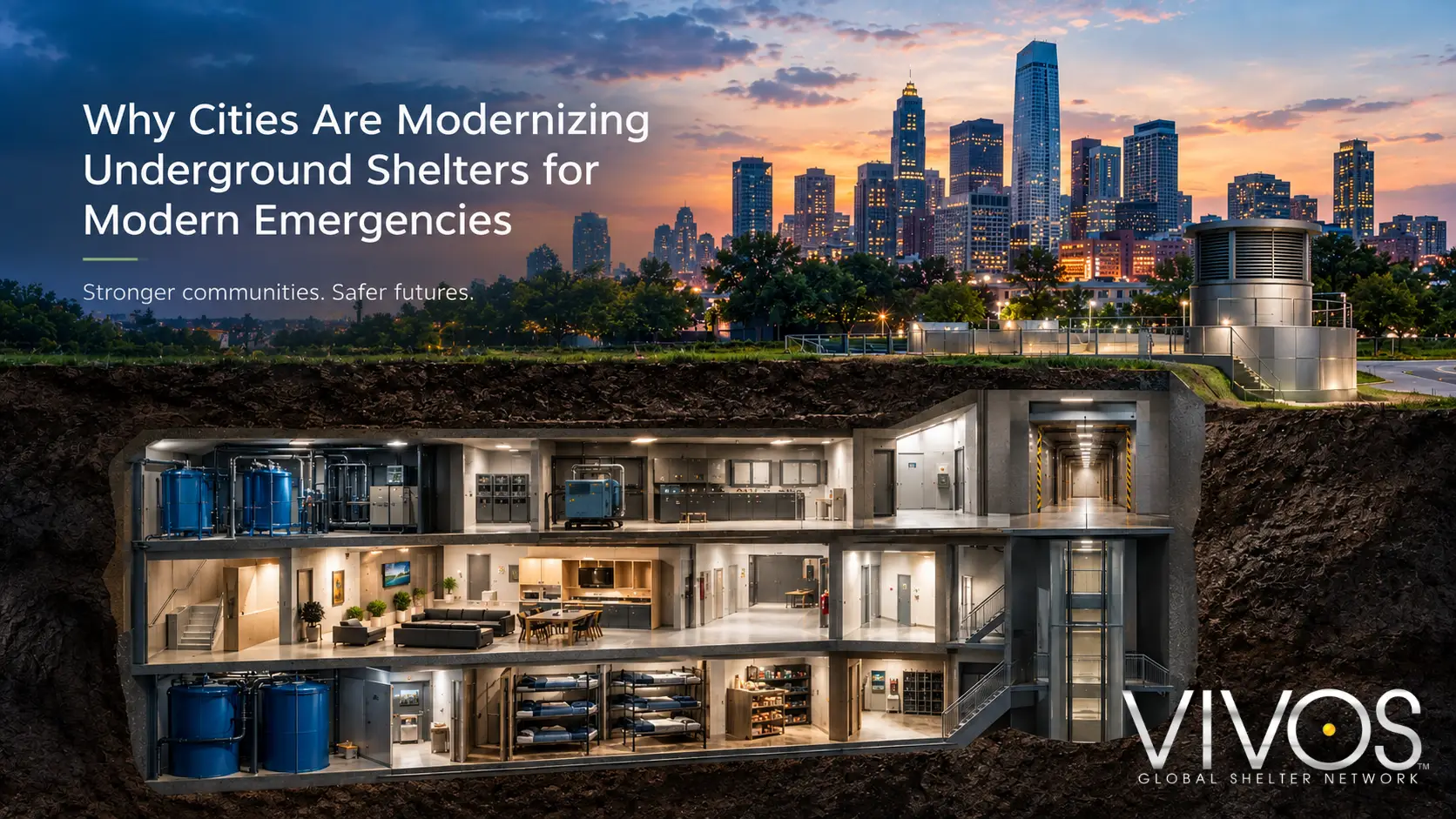
 For decades, underground shelters were closely associated with the Cold War. Many were built to protect civilians from military attacks and then became part of ordinary urban infrastructure.
Today, that infrastructure is receiving renewed attention.
Cities and governments are reassessing the condition, capacity, and capabilities of civil-defence shelters as they prepare for a wider range of emergencies, including armed conflict, infrastructure disruption, extreme events, and other situations that could affect large populations.
Recent developments across Europe demonstrate this shift. Finland has been testing its civil-defence shelter systems against modern threats, Ukraine is developing a nationwide shelter network, and cities such as Helsinki continue investing in civil-defence preparedness and shelter infrastructure.
The change is about more than repairing old bunkers.
It reflects a broader understanding of what community resilience requires when normal infrastructure is disrupted.
Why Are Underground Shelters Receiving New Attention?
Modern cities depend on interconnected systems.
Electricity supports water treatment and communications. Transportation networks move people and supplies. Telecommunications support emergency coordination. Hospitals depend on reliable power, water, communications, and supply chains.
When one major system fails, the effects can spread across many others.
That is why emergency planning increasingly considers not only how people can evacuate, but also how communities can protect and support people when remaining in place becomes necessary.
Underground shelters can provide one component of that larger resilience strategy.
A properly designed civil-defence facility can offer a protected environment while incorporating systems for ventilation, emergency power, communications, sanitation, and other essential functions.
The objective is therefore changing from simply having a place to hide to having infrastructure capable of supporting people during a serious disruption.
Finland Is Reassessing Its Shelter Infrastructure
Finland provides one of the clearest examples of long-term investment in community shelter infrastructure.
Helsinki maintains both building-specific shelters and large shelters carved into the city’s bedrock. Some underground facilities have everyday uses such as parking, sports, recreation, and transportation infrastructure, while retaining the ability to function as civil-defence shelters when required.
The City of Helsinki has also identified strengthening civil defence and investing in the construction and renovation of civil-defence shelters as part of its security and preparedness priorities.
This approach demonstrates an important principle:
Shelter infrastructure does not necessarily need to remain unused until an emergency occurs.
Large underground facilities can contribute to everyday urban life while retaining emergency capabilities.
That makes them part of the city’s broader infrastructure rather than isolated emergency structures.
Modern Threats Require Modern Shelter Systems
In September 2026, Finland’s Ministry of the Interior and the Finnish Defence Forces conducted blast tests on civil-defence shelters in Rovaniemi.
The tests were particularly notable because similar tests had last been carried out in 1992. International experts involved in Ukraine’s civil-protection shelter program also attended the testing, with the stated goal of improving Finnish shelter solutions and sharing lessons between countries.
This illustrates an important point about long-term infrastructure:
A shelter built decades ago cannot simply be assumed to meet every modern requirement.
Materials, technology, threats, building standards, communications systems, ventilation technology, and emergency procedures can all change.
Modernization therefore involves evaluating whether existing facilities remain capable of performing their intended functions.
Ukraine Is Moving Toward a Nationwide Shelter Network
Ukraine provides another example of how emergency conditions can accelerate the development of large-scale shelter infrastructure.
In 2025, Ukraine and European partners launched the International Civil Protection Shelter Coalition with the goal of moving from inconsistent, ad-hoc shelters toward a more organized and standards-based national shelter network. The strategy extends through 2034.
The initiative is not limited to traditional military-style bunkers.
In February 2026, the coalition approved its first projects to construct and modernize protective shelters at hospitals and day-care facilities in several Ukrainian regions. Four projects involved hospitals and three involved day-care facilities.
This shows another important development in community protection:
Shelters can be integrated with essential community services.
Protecting a population is not only about providing a reinforced underground space. It can also mean protecting the facilities and services communities depend on.
Shelter Infrastructure Can Help Protect Critical Services
Consider a hospital during a major emergency.
If the building remains operational but its infrastructure is vulnerable, medical services may be interrupted precisely when demand increases.
A protected shelter integrated into or near an essential facility can provide an additional layer of resilience.
The same principle can apply to:
- Schools and day-care facilities
- Emergency coordination centers
- Transportation infrastructure
- Utility facilities
- Communications systems
- Medical services
- Community gathering points
The objective is not necessarily to place an entire city underground.
Instead, communities can develop layers of protected infrastructure capable of supporting people and essential services during different types of emergencies.
Modernization Is About Systems, Not Just Structures
One of the biggest misconceptions about underground shelters is that protection comes primarily from concrete, steel, and depth.
Physical construction is important, but it is only one part of the equation.
A functional community shelter also needs supporting systems.
For a practical evaluation checklist, read our guide on what to look for in an underground survival shelter.
Ventilation and Air Management
People cannot remain underground for extended periods without appropriate air-management systems.
Modern shelter planning therefore needs to consider ventilation, filtration, pressure management, and the ability to operate when outside air conditions are unsafe.
Emergency Power
A shelter may depend on electricity for ventilation, lighting, communications, pumps, monitoring systems, and other essential equipment.
Emergency power and appropriate backup systems can therefore be critical components of shelter resilience.
Water and Sanitation
Large groups of people require reliable access to water and sanitation.
These systems become increasingly important as the expected duration of shelter occupancy increases.
Communications
People inside a shelter need access to reliable information.
Shelter operators also need ways to communicate with emergency authorities and coordinate activities within the facility.
Emergency Access and Evacuation
Protected infrastructure still needs safe access routes, emergency exits, fire protection, and systems that allow people to move safely through the facility.
These requirements demonstrate why modernizing a shelter is a multidisciplinary infrastructure project rather than simply a construction project.
Dual-Use Infrastructure Offers Another Model
Helsinki’s underground facilities demonstrate another approach that may be relevant to future community infrastructure.
Some large underground shelters are used during normal conditions for parking, sports, recreation, and other purposes. Several underground metro stations can also serve as civil-defence shelters when necessary.
This dual-use model offers a practical advantage.
Infrastructure that serves a useful purpose every day can be maintained, occupied, and integrated into the community instead of remaining unused for long periods.
It also means emergency infrastructure can become part of broader urban planning.
For future cities, this raises an interesting question:
Could more underground community facilities be designed from the beginning to serve both everyday and emergency purposes?
Why Community-Scale Shelters Matter
A private shelter can address the needs of a limited number of people.
Unlike a private bunker, an underground survival community can bring together shared infrastructure, resources, and people with different skills.
A city, however, faces a much larger challenge.
When an emergency affects thousands or millions of people, communities need infrastructure that can operate at scale.
That means considering:
- Population capacity
- Access and distribution
- Food and water
- Medical support
- Emergency power
- Communications
- Sanitation
- Ventilation
- Security
- Emergency management
- Long-term occupancy
This is where the concept of a community survival shelter differs from the traditional image of a private bunker.
The purpose is not simply to protect an individual household.
It is to create infrastructure capable of supporting a larger community through a serious disruption.
The Importance of Regular Testing and Maintenance
Building a shelter is only the beginning.
Underground infrastructure can deteriorate. Mechanical systems become outdated. Electrical equipment requires maintenance. Emergency procedures can become obsolete. Personnel change.
Regular inspections, testing, training, and exercises help ensure that a shelter remains operational when it is actually needed.
Finland’s 2026 blast testing is one example of how shelter capabilities can be reassessed decades after earlier testing.
Similarly, Ukraine’s current shelter-development efforts demonstrate that modern shelter programs increasingly involve standards, construction requirements, coordination, and long-term planning rather than simply identifying an existing underground room.
From Emergency Bunkers to Community Resilience
The renewed interest in underground shelters does not necessarily mean cities are returning to the Cold War model.
Instead, it may represent an evolution in how communities think about resilience.
Modern emergency planning increasingly considers multiple overlapping risks.
A city may need to prepare for:
- Armed conflict
- Infrastructure failures
- Extended power disruptions
- Extreme weather
- Natural disasters
- Communications failures
- Supply-chain interruptions
- Other large-scale emergencies
No single facility can solve every problem.
But protected infrastructure can provide an important layer within a broader preparedness strategy.
This is why cities are increasingly considering shelters as part of community resilience infrastructure rather than treating them solely as emergency bunkers.
What Cities Can Learn From Shelter Modernization
Several lessons emerge from recent developments.
1. Existing infrastructure should be reassessed
Older shelters may still provide value, but their condition and capabilities need to be evaluated against current requirements.
2. Shelter planning should consider the entire community
Capacity, access, essential services, and emergency operations all matter when infrastructure is intended to protect large populations.
3. Underground facilities can have multiple purposes
Dual-use facilities can contribute to everyday community life while retaining emergency capabilities.
4. Critical systems need redundancy
Power, water, communications, ventilation, and other essential systems should be considered as part of the shelter’s overall resilience.
5. Preparedness requires ongoing investment
A shelter cannot simply be built and forgotten. Maintenance, testing, training, and modernization are ongoing requirements.
The Future of Community Survival Infrastructure
The renewed investment in civil-defence shelters suggests that the future of emergency infrastructure may be increasingly focused on resilience rather than simple protection.
The question is no longer only:
“Where can people take shelter?”
It is also:
“How can a community continue functioning when normal infrastructure is disrupted?”
Answering that question requires a broader approach involving protected spaces, reliable resources, independent systems, emergency planning, and coordinated community operations.
Large-scale survival communities are built around many of these same principles.
TerraVivos focuses on community-scale survival infrastructure designed around long-term preparedness rather than the concept of a private backyard bunker.
Learn more about why people join underground survival communities and the role shared resources and community preparedness can play in long-term resilience.
The experience of cities such as Helsinki and the broader development of civil-protection networks demonstrate why communities are giving greater attention to protected infrastructure, redundancy, and long-term resilience.
The modern survival shelter is therefore becoming more than a reinforced underground space.
It can be part of a larger strategy for helping communities protect people, preserve essential resources, and maintain continuity when ordinary systems are no longer dependable.
Preparing for a More Resilient Future
The renewed attention to underground shelters around the world offers an important lesson.
Resilience is easier to build before an emergency than during one.
Cities that invest in protected infrastructure, maintain their systems, conduct regular exercises, and plan for large-scale disruptions can create additional layers of protection for their populations.
For TerraVivos, this broader concept of community resilience is central to the idea of large-scale survival communities.
The goal is not simply to go underground.
It is to create an environment where people, infrastructure, resources, and preparedness can work together when conventional systems are under severe pressure.
Explore Terra Vivos’ underground survival shelters to learn about the different facilities and preparedness options available.


