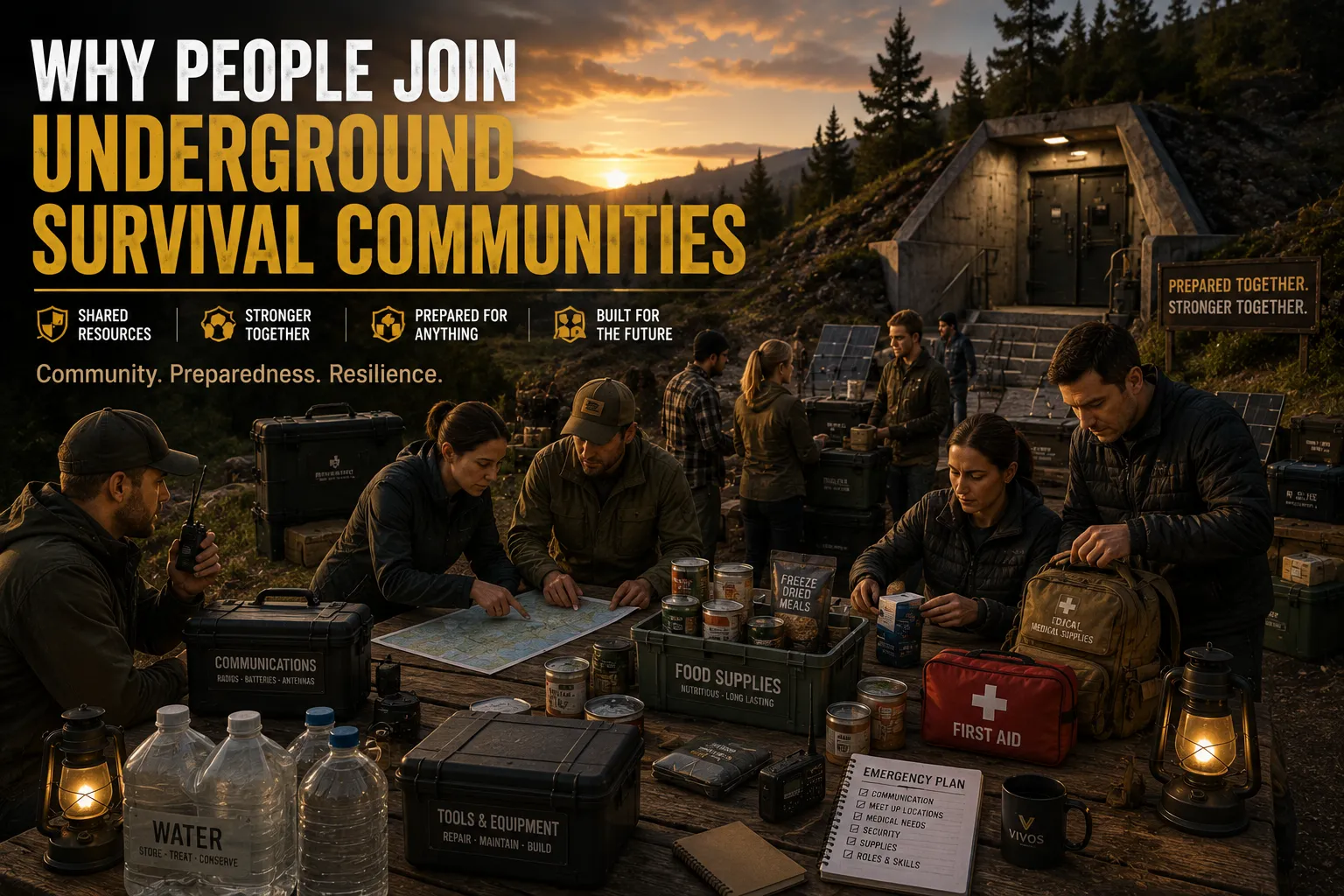
Why Community-Based Preparedness Is Gaining Attention
For many years, emergency preparedness focused primarily on individual households: storing food and water, keeping emergency supplies, and having a backup power source.
Today, some families are thinking beyond short-term emergencies.
Extended power outages, severe weather, infrastructure failures, supply chain disruptions, and geopolitical uncertainty have encouraged more people to consider how they would manage if normal systems were unavailable for weeks or longer.
This has increased interest in underground survival communities—facilities designed to bring multiple families together with shared infrastructure, resources, security, and long-term preparedness.
But why would someone choose to join a survival community instead of preparing alone?
Why Are People Considering Underground Survival Communities?
A major emergency can affect much more than a family’s immediate supply of food and water.
Electricity, communications, transportation, fuel, healthcare, and supply chains can all be disrupted at the same time.
Preparing alone can provide a valuable level of independence, but long-term resilience can require resources and expertise that are difficult for one household to maintain.
A community-based shelter approaches preparedness differently.
Instead of every family attempting to maintain everything independently, residents can benefit from shared infrastructure, diverse skills, organized security, and community support.
1. Shared Infrastructure
One of the biggest reasons people consider underground survival communities is access to infrastructure designed for more than one household.
Depending on the facility, this may include:
- Independent or backup power
- Water storage and purification
- Air filtration
- Food storage
- Secure living areas
- Communications systems
- Medical facilities or resources
- Common areas
Maintaining this level of infrastructure independently can be expensive and complicated.
A community model allows resources and responsibilities to be shared among members.
2. Greater Security
Security is another important consideration during prolonged emergencies.
If access to food, fuel, water, or medical supplies becomes limited, communities may face additional pressure.
A professionally designed underground community can incorporate controlled access, secure entrances, emergency procedures, and shared security responsibilities.
Rather than relying on one household to manage every aspect of security, a community can organize people and resources around a common environment.
The specific security measures vary by facility, so prospective members should always understand what a shelter actually provides before making a decision.
3. Access to Diverse Skills
Long-term survival requires more than equipment.
It also requires people who know how to operate, repair, and manage essential systems.
A community may include people with experience in:
- Medicine
- Engineering
- Construction
- Agriculture
- Electrical systems
- Mechanical maintenance
- Communications
- Security
- Education
No single family can realistically possess expertise in every area.
This is one of the biggest advantages of community-based preparedness: people themselves become part of the survival infrastructure.
4. Long-Term Food and Water Planning
Food and water are among the most important considerations during any extended emergency.
A short-term emergency supply may be sufficient for several days or weeks, but longer disruptions create additional challenges.
Communities can plan collectively for:
- Food storage
- Water reserves
- Water purification
- Food preparation
- Supply management
- Resource allocation
This doesn’t mean resources are unlimited.
It means the community can approach essential resources through coordinated planning rather than leaving every household to solve the problem independently.
5. Backup Power and Essential Systems
Modern life depends heavily on electricity.
Power supports refrigeration, communications, water systems, heating and cooling, medical equipment, security systems, and many other essential functions.
For this reason, underground survival communities may incorporate independent or backup infrastructure designed to reduce dependence on public utilities during emergencies.
The goal is not simply to provide electricity.
It is to support the systems necessary for continued occupancy and daily life during a prolonged disruption.
6. Community and Social Support
Preparedness discussions often focus on physical survival, but long-term emergencies also create social and psychological challenges.
Living in complete isolation for an extended period can be difficult.
A community can provide:
- Social interaction
- Shared responsibilities
- Education
- Recreation
- Group activities
- Emotional support
- A sense of purpose
For families, especially those with children, maintaining some degree of normal social interaction can be an important part of long-term resilience.
A survival community isn’t simply about living underground.
It’s about creating an environment where people can continue functioning as a community.
7. Preparing for Multiple Threats
Most people cannot predict what type of emergency they may eventually face.
Potential disruptions could include:
- Severe weather
- Wildfires
- Extended power outages
- Infrastructure failures
- Supply chain disruptions
- Cyber incidents
- Civil unrest
- Geopolitical conflicts
- Economic disruptions
Rather than preparing for one specific event, community-based preparedness focuses on maintaining resilience across multiple scenarios.
This broader approach is one reason underground shelters continue to attract interest among people planning for long-term emergencies.
Underground Survival Community vs. Private Bunker
Both private bunkers and community shelters can serve different preparedness goals.
| Private Bunker | Underground Survival Community |
| Greater privacy | Shared community environment |
| More individual control | Shared infrastructure |
| Primarily self-reliant | Shared resources and responsibilities |
| Limited household expertise | Diverse community skills |
| Individual maintenance | Shared infrastructure maintenance |
For someone who prioritizes privacy and independence, a private bunker may be preferable.
For someone looking for shared infrastructure, community support, and long-term resilience, an underground survival community may be a better fit.
For a deeper comparison, see our guide: Underground Survival Communities vs. Private Bunkers: Which Is Safer?
What Should You Consider Before Joining?
Joining an underground survival community is a significant decision. Prospective members should evaluate several factors before committing.
Location
Consider geography, accessibility, climate, population density, and potential natural hazards.
Infrastructure
Understand the facility’s power, water, air filtration, communications, and other essential systems.
Community Rules
Living with other families requires cooperation. Review occupancy rules, responsibilities, and community policies.
Supplies
Determine what the community provides and what individual members are expected to bring or maintain.
Costs
Consider membership costs along with transportation, personal supplies, ongoing expenses, and other financial commitments.
Emergency Planning
Understand how the community handles medical emergencies, security issues, evacuations, and other unexpected situations.
Preparedness decisions should be based on careful research rather than fear.
How Terra Vivos Approaches Community-Based Preparedness
Terra Vivos focuses on large-scale underground survival communities designed around long-term preparedness and community resilience.
Rather than focusing exclusively on individual family bunkers, Terra Vivos develops shelter environments where members can benefit from shared infrastructure and community resources.
Vivos xPoint
Located near Edgemont, South Dakota, Vivos xPoint was developed from a former U.S. Army munitions facility and includes hundreds of hardened military-built bunkers.
Its location and existing infrastructure make it one of the most distinctive underground survival communities available today.
Vivos Europa One
Located inside a former Cold War military fortress in Germany, Vivos Europa One is designed as a large-scale underground shelter complex with extensive living and community areas.
Vivos Indiana
Vivos Indiana is another Terra Vivos community-based shelter project designed to provide a secure environment for long-term preparedness.
Together, these projects reflect Terra Vivos’ approach to combining underground protection, shared infrastructure, and community-based resilience.
Preparedness Is About Creating Options
Nobody can predict exactly when or how a major emergency will occur.
A crisis could involve a natural disaster, prolonged infrastructure failure, power outage, supply disruption, or geopolitical event.
What individuals can control is how they prepare.
Joining an underground survival community does not eliminate every risk, and no shelter can guarantee safety in every possible scenario.
However, for people planning beyond short-term emergency supplies, community-based shelters offer another approach—one built around shared resources, infrastructure, skills, and cooperation.
Explore Terra Vivos Underground Survival Communities
If you’re considering long-term preparedness, explore Terra Vivos’ underground survival communities and available shelter options.
Explore Related Resources
- Vivos xPoint
- Vivos Europa One
- Vivos Indiana
- View All Available Shelters
- Membership Application
- Contact Terra Vivos
Explore Terra Vivos Available Shelters
Final Thoughts
People join underground survival communities for different reasons.
Some want greater protection for their families. Others value shared infrastructure, diverse expertise, security, or the ability to prepare for longer-term disruptions.
The central idea is simple:
Long-term resilience can be difficult to achieve alone.
Community-based preparedness allows people to combine resources, knowledge, infrastructure, and responsibilities in ways that may be difficult for a single household to accomplish.
Preparedness isn’t about predicting the future.
It’s about creating options before they are needed.
Frequently Asked Questions
Why do people join underground survival communities?
People may join for shared infrastructure, security, access to diverse skills, community support, and preparation for prolonged emergencies.
Are underground survival communities better than private bunkers?
It depends on individual priorities. Private bunkers offer greater privacy and control, while community shelters emphasize shared infrastructure, resources, and expertise.
What can an underground survival community provide?
Features vary, but facilities may include secure living spaces, power systems, water resources, air filtration, food storage, communications, and shared community areas.
Can families live in underground survival communities?
Many community-based shelters are designed to accommodate individuals and families. Occupancy rules and available living arrangements vary by facility.
What is Terra Vivos?
Terra Vivos develops large-scale underground survival communities focused on long-term preparedness, hardened shelter infrastructure, shared resources, and community resilience.
How can I learn more about Terra Vivos?
You can explore available shelters, review individual Terra Vivos projects, or contact the Terra Vivos team to learn more about membership and preparedness options.


