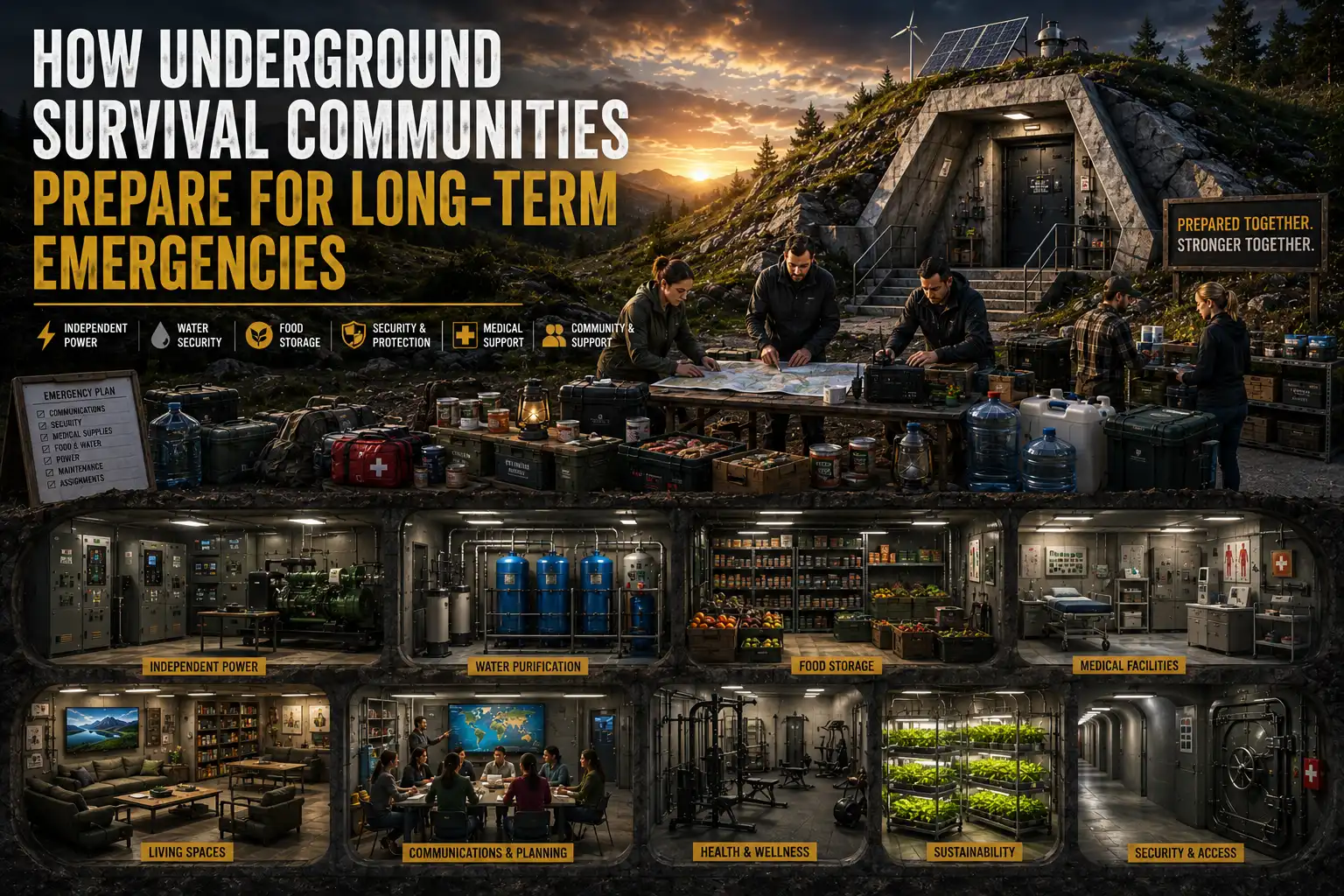
Most emergency preparedness plans focus on surviving for a few days. But what happens when a crisis lasts for weeks, months, or longer?
Extended power outages, major natural disasters, infrastructure failures, supply chain disruptions, and geopolitical events can place enormous pressure on essential services.
For those considering long-term preparedness, underground survival communities offer a different approach: combining secure shelter, independent infrastructure, stored resources, and community support in one environment.
What Does Long-Term Preparedness Require?
Surviving a prolonged emergency involves much more than storing food.
A resilient underground community may need systems for:
- Food and water
- Power generation
- Air filtration
- Medical support
- Communications
- Security
- Waste management
- Maintenance and repairs
The goal is to reduce dependence on outside infrastructure when normal services may be unavailable.
1. Independent Power Systems
Electricity is essential for almost every aspect of modern life.
Underground survival communities can incorporate backup and independent power systems to support critical operations such as:
- Lighting
- Ventilation
- Water systems
- Communications
- Refrigeration
- Medical equipment
Multiple layers of power resilience can help communities continue operating during extended grid disruptions.
2. Water Security
Clean drinking water is one of the most important resources during any emergency.
Long-term shelter communities may use combinations of:
- Water wells
- Storage systems
- Purification equipment
- Filtration systems
- Water conservation practices
Reliable water infrastructure can significantly improve long-term sustainability.
3. Food Storage and Supply Planning
A long-term shelter needs more than a few emergency meals.
Communities can prepare through:
- Long-term food storage
- Controlled food inventories
- Food preparation facilities
- Agricultural planning
- Resource management
Shared storage also allows resources to be managed collectively rather than relying on each household to maintain everything independently.
4. Air Filtration and Environmental Protection
Underground shelters can provide an additional layer of protection from certain environmental hazards.
Advanced filtration systems may be designed to help protect occupants from airborne contaminants, including nuclear, biological, and chemical (NBC) threats, depending on the facility’s engineering and specifications.
Maintaining controlled indoor air quality is particularly important when outside conditions are unsafe.
5. Security and Controlled Access
Long-term emergencies can create additional security challenges.
Large underground communities can incorporate:
- Controlled entrances
- Security systems
- Reinforced structures
- Trained personnel
- Community rules and procedures
A structured security approach can be difficult for an individual household to replicate on its own.
6. Medical and Community Support
Long-term emergencies can create medical and psychological challenges.
A community environment allows people with different skills and experience to contribute, including:
- Medical professionals
- Engineers
- Technicians
- Agricultural specialists
- Communications specialists
- Maintenance personnel
This shared knowledge can become particularly valuable during prolonged disruptions.
7. Maintaining Daily Life
Long-term survival isn’t simply about staying alive.
People also need routines, social interaction, education, recreation, and meaningful responsibilities.
This is one advantage of community-based preparedness. Residents can share responsibilities while maintaining a more structured environment during an extended emergency.
How Terra Vivos Approaches Long-Term Preparedness
Terra Vivos focuses on large-scale underground survival communities designed around security, sustainability, shared infrastructure, and long-term resilience.
Its projects include:
- Vivos xPoint — A large underground survival community in South Dakota featuring hundreds of hardened military-built bunkers.
- Vivos Europa One — An underground survival complex developed within a former Cold War military facility in Germany.
- Vivos Indiana — A community-based underground shelter designed for long-term preparedness.
These projects demonstrate how underground preparedness can extend beyond a simple private bunker by combining shelter infrastructure with community resources.
Why Community Preparedness Matters
No individual can easily maintain every system required for long-term self-sufficiency.
A functioning community can distribute responsibilities across many people, creating a broader network of skills and resources.
That can make community-based preparedness particularly relevant for people thinking beyond short-term emergencies.
Prepare Before You Need It
Long-term emergencies are difficult to predict.
But preparation doesn’t require predicting exactly what will happen.
It means creating options before:
- Power becomes unavailable
- Supplies become difficult to obtain
- Transportation is disrupted
- Emergency services become overwhelmed
- Infrastructure begins failing
Whether your preparedness plan begins with emergency supplies or extends to an underground survival community, planning ahead provides more options than waiting until a crisis begins.
Explore Terra Vivos Survival Communities
Learn more about Terra Vivos and its underground survival communities:
- Vivos xPoint
- Vivos Europa One
- Vivos Indiana
- Available Shelters
- Membership Application
- Contact Terra Vivos
Final Thoughts
Long-term preparedness requires more than a secure room and stored supplies.
It requires water, power, food, air management, security, medical capabilities, maintenance, and people with the skills to keep essential systems operating.
Underground survival communities bring many of these elements together in a shared environment designed for resilience.
For families considering preparedness beyond short-term emergencies, understanding how these communities operate can be an important first step toward making an informed decision.
Frequently Asked Questions
How do underground survival communities prepare for long-term emergencies?
They can combine secure shelter with independent power, water systems, food storage, air filtration, communications, security, and shared community resources.
How long can an underground survival community operate?
The duration depends on the specific facility, infrastructure, stored resources, occupancy, and emergency scenario. Each shelter should be evaluated based on its documented capabilities.
Why is community important for long-term survival?
Communities can share skills, responsibilities, resources, and infrastructure that may be difficult for one family to maintain independently.
What systems are important in an underground shelter?
Key systems can include power, water, air filtration, food storage, communications, security, sanitation, and maintenance infrastructure.
Does Terra Vivos offer community-based underground shelters?
Yes. Terra Vivos develops and operates several underground survival communities, including Vivos xPoint, Vivos Europa One, and Vivos Indiana.


