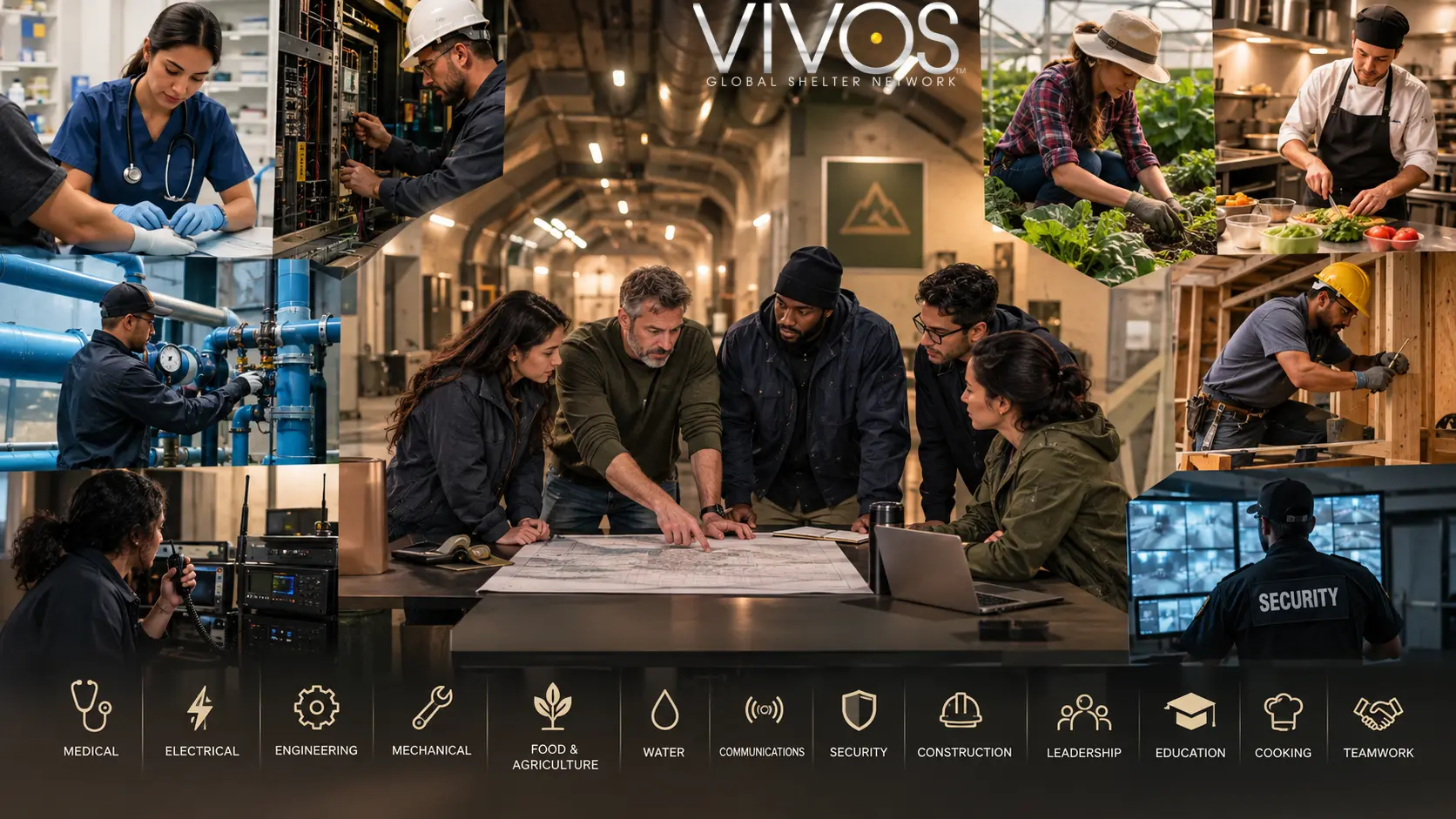
When people think about emergency preparedness, they often focus on supplies: food, water, power, shelter, and medical equipment.
But in a long-term emergency, people and their skills can be just as important as physical resources.
An underground survival community may bring together individuals and families with different professional backgrounds, practical abilities, and life experience. During a prolonged disruption, these skills can help communities maintain essential systems, manage resources, solve problems, and continue daily life.
No single person needs to know how to do everything. One of the potential strengths of a community-based preparedness model is that different people can contribute different capabilities.
Why Skills Matter During a Long-Term Emergency
Short-term emergencies can often be managed with stored supplies and basic emergency equipment.
Longer disruptions can create more complicated challenges.
Equipment may require maintenance. Food and water need to be managed. Power systems need to operate properly. Medical issues may arise. Communication systems may need to be maintained, while everyday responsibilities still have to be organized.
This is where practical skills become valuable.
A well-prepared community can benefit from people who understand areas such as:
- Medicine
- Engineering
- Electrical systems
- Mechanical maintenance
- Food production
- Water management
- Communications
- Construction
- Security
- Education
- Organization and leadership
The objective is not to create a community where everyone has the same skills.
It is to create an environment where different skills can complement one another.
1. Medical and First-Aid Skills
Medical knowledge can be particularly valuable when access to normal healthcare services is limited.
Doctors, nurses, paramedics, EMTs, pharmacists, and people with first-aid training can potentially contribute to:
- First aid
- Injury assessment
- Basic medical care
- Emergency response
- Medication management
- Health monitoring
- Medical preparedness
Even people without professional medical backgrounds can benefit from knowing basic first aid, CPR, emergency response, and how to maintain a personal medical kit.
A community should also understand the limits of its medical capabilities and have appropriate emergency procedures.
2. Electrical and Power-System Skills
Electricity can support many essential functions inside a survival community.
Power may be needed for:
- Lighting
- Water systems
- Ventilation
- Air filtration
- Refrigeration
- Communications
- Medical equipment
- Climate control
- Security systems
Electricians, electrical engineers, technicians, and people experienced with generators or energy systems can therefore provide valuable knowledge.
Their role may involve monitoring equipment, identifying problems, performing appropriate maintenance, and helping the community use available power efficiently.
3. Engineering and Technical Skills
Underground facilities can contain complex structural, mechanical, electrical, and environmental systems.
Engineers and technically experienced residents may contribute to:
- Infrastructure maintenance
- Mechanical systems
- Equipment troubleshooting
- Structural assessments
- Energy systems
- Water systems
- Ventilation
- Problem-solving
Technical expertise can become especially important when replacement parts, outside contractors, or normal maintenance services are difficult to access.
4. Mechanical and Maintenance Skills
Not every problem during an emergency is a major disaster.
Sometimes it is a broken pump, damaged equipment, malfunctioning appliance, or mechanical system that needs attention.
People with experience in:
- Automotive repair
- Machinery
- Plumbing
- HVAC
- Welding
- General maintenance
- Equipment repair
can contribute practical capabilities that help keep everyday systems functioning.
Maintenance is particularly important in a long-term environment because equipment that works today still needs to work weeks or months later.
5. Food and Agriculture Skills
Food storage is an important component of emergency preparedness, but long-term food management involves more than keeping supplies on shelves.
People with experience in agriculture, gardening, food preparation, preservation, or nutrition may contribute to:
- Food preparation
- Meal planning
- Food preservation
- Inventory management
- Gardening
- Resource management
- Nutrition planning
The exact role of food production depends on the facility’s design and available resources.
The broader principle is that people who understand how to manage food resources can become valuable members of a preparedness community.
6. Water Management Skills
Water is essential for drinking, sanitation, food preparation, medical needs, and daily living.
People with experience in plumbing, water treatment, environmental systems, or infrastructure management can contribute to:
- Water storage
- Water purification
- Water distribution
- Plumbing maintenance
- Conservation
- Wastewater management
Water systems should be managed carefully because a disruption can affect many other aspects of community life.
7. Communications Skills
Communication becomes particularly important when normal communication networks are disrupted.
People with experience in radio, telecommunications, networking, or emergency communications can help with:
- Internal communication
- Radio operations
- Equipment maintenance
- Information sharing
- Network management
- Emergency communication procedures
Reliable communication can help residents coordinate activities and stay informed about conditions outside the community when external communication remains available.
8. Security and Situational Awareness
Security can be another important component of long-term preparedness.
People with relevant experience may contribute to:
- Access control
- Monitoring
- Emergency procedures
- Security planning
- Incident response
- Situational awareness
Security responsibilities should operate within the community’s established rules and procedures.
The goal is to help maintain a safe and organized environment rather than relying on individual actions.
9. Construction and Building Skills
Construction and repair skills can become valuable when facilities need ongoing maintenance.
People with experience in:
- Carpentry
- Masonry
- Plumbing
- Electrical work
- Metalworking
- General construction
may be able to assist with appropriate repairs and maintenance tasks.
Practical building knowledge can also help communities make efficient use of available materials and resources.
10. Leadership and Organization
Technical skills are important, but communities also need people who can organize activities and responsibilities.
Leadership and organizational skills can help with:
- Scheduling
- Resource management
- Task coordination
- Community meetings
- Emergency planning
- Conflict resolution
- Decision-making
Effective organization becomes increasingly important as the number of residents increases.
A large community cannot function efficiently if responsibilities and expectations are unclear.
11. Education and Teaching Skills
Long-term emergencies can create a need for continued education, particularly when families with children are involved.
Teachers and people with educational experience can contribute to:
- Children’s education
- Skill development
- Training programs
- Workshops
- Knowledge sharing
- Community activities
Education can also extend beyond children.
Residents can teach one another practical skills, creating opportunities for the community to become less dependent on a small number of specialists.
12. Cooking and Food Preparation
Cooking may seem like an ordinary household activity, but it can become an important community function during extended sheltering.
People with cooking experience can help with:
- Meal preparation
- Food rotation
- Portion management
- Menu planning
- Food safety
- Efficient use of stored ingredients
Shared meal preparation can also contribute to maintaining routines and social interaction within the community.
13. Communication, Social, and Interpersonal Skills
Not every valuable skill is technical.
Long-term community living requires people who can communicate clearly, cooperate with others, listen, resolve disagreements, and work as part of a team.
Interpersonal skills can help with:
- Teamwork
- Conflict resolution
- Community cooperation
- Supporting other residents
- Organizing activities
- Maintaining positive relationships
A community is ultimately made up of people, so the ability to work with others can be just as relevant as technical expertise.
14. Adaptability and Problem-Solving
Perhaps one of the most useful general abilities is the capacity to adapt.
Emergencies rarely follow a perfectly predictable plan.
People may need to:
- Find alternative solutions
- Work with limited resources
- Learn unfamiliar tasks
- Repair equipment
- Adjust schedules
- Solve unexpected problems
- Cooperate under changing circumstances
Someone who can calmly assess a problem and help develop a practical solution can contribute even without having a specialized profession.
Skills Can Be Shared Across the Community
One of the advantages of community-based preparedness is that knowledge doesn’t have to remain with one person.
For example:
An electrician can teach basic electrical safety.
A medical professional can teach first aid.
A mechanic can demonstrate basic equipment maintenance.
A gardener can teach food-growing techniques.
A communications specialist can teach radio procedures.
This creates an opportunity for knowledge redundancy.
If only one person understands an important system, the community can become dependent on that individual. Sharing knowledge with others can help create greater resilience.
Why Diverse Skills Matter
Imagine a community where everyone has the same professional background.
It might have significant expertise in one area but limited knowledge in many others.
A diverse community can potentially bring together people with different capabilities.
| Skill Area | Potential Contribution |
| Medicine | First aid and medical support |
| Electrical | Power systems and maintenance |
| Engineering | Technical infrastructure |
| Mechanical | Equipment repair |
| Agriculture | Food production and management |
| Plumbing | Water and sanitation systems |
| Communications | Radio and communication systems |
| Construction | Repairs and maintenance |
| Security | Access and emergency procedures |
| Education | Teaching and training |
| Cooking | Food preparation and management |
| Leadership | Organization and coordination |
The value isn’t simply in the number of skilled people.
It is in how those skills work together.
Community Skills vs. Individual Preparedness
Preparing alone can provide a valuable level of independence, but one household cannot realistically maintain expertise in every field.
A community-based approach can distribute responsibilities across multiple people.
For example:
Individual household
Food + water + medical supplies + basic tools + emergency planning
Community
Power + water infrastructure + communications + maintenance + security + medical knowledge + shared resources
This doesn’t mean community preparedness replaces individual responsibility.
Instead, the two approaches can complement one another.
For more information, read Why People Join Underground Survival Communities.
How Terra Vivos Approaches Community-Based Preparedness
Terra Vivos focuses on large-scale underground survival communities designed around protection, infrastructure, shared resources, and community resilience.
Its projects include different shelter environments intended for individuals, families, and larger groups.
Vivos xPoint
Vivos xPoint near Edgemont, South Dakota, includes hundreds of hardened military-built bunkers developed into a large underground survival community.
Vivos Europa One
Vivos Europa One is located within a former Cold War military facility in Germany and is designed as a large-scale underground survival complex.
Vivos Indiana
Vivos Indiana is another Terra Vivos community-based shelter designed around long-term preparedness.
Each facility has its own characteristics, infrastructure, membership arrangements, and requirements. Prospective members should review the specific details of the community they are considering.
What Skills Should You Develop?
You don’t need to become an expert in every area.
A practical approach is to identify the skills you already have and then develop capabilities that complement them.
Consider learning:
- First aid and CPR
- Basic electrical safety
- Basic mechanical maintenance
- Food preservation
- Gardening
- Water purification
- Emergency communications
- Basic construction and repair
- Emergency planning
- Teamwork and leadership
The objective is not to become a survival expert overnight.
It is to become more useful, adaptable, and prepared.
Final Thoughts
A survival community is built from more than concrete, equipment, and stored supplies.
Its people are an important part of its resilience.
Doctors, engineers, mechanics, electricians, farmers, teachers, technicians, cooks, communicators, and many others can contribute different skills to a shared environment.
Just as importantly, people can learn from one another.
Long-term preparedness is not necessarily about knowing how to do everything yourself. It can also be about building a community where knowledge, skills, resources, and responsibilities can be shared.
For people considering an underground survival community, understanding how their own skills could contribute—and what skills they may want to develop—is an important part of preparedness.
Explore Terra Vivos
Learn more about Terra Vivos underground survival communities and available shelter options:
- Vivos xPoint
- Vivos Europa One
- Vivos Indiana
- Available Shelters
- Membership Application
- Contact Terra Vivos
Frequently Asked Questions
What skills are most valuable in a survival community?
Medical, electrical, mechanical, engineering, food, water management, communications, construction, security, education, cooking, and organizational skills can all contribute to community resilience.
Do you need professional skills to contribute to a survival community?
No. Practical abilities, first-aid knowledge, adaptability, teamwork, and a willingness to learn can all be useful. Communities can benefit from a wide range of skills and experience.
Why are medical skills important in a survival community?
Medical and first-aid knowledge can help residents respond to injuries and basic medical needs when access to outside healthcare may be limited.
Why are technical skills important underground?
Underground communities can rely on complex power, water, ventilation, communications, and other infrastructure. People with relevant technical knowledge may help operate, monitor, and maintain these systems.
Can survival skills be taught to other community members?
Yes. Knowledge sharing and cross-training can help ensure that important capabilities are not concentrated in only one or two people.
Is community preparedness better than preparing alone?
The two approaches address different needs. Individual preparedness provides household-level resources and independence, while community preparedness can provide shared infrastructure, expertise, responsibilities, and social support.
How can I prepare my own skills for an emergency?
Start with practical areas such as first aid, emergency planning, food and water management, basic maintenance, communication, and problem-solving. Then build skills based on your personal circumstances and interests.


