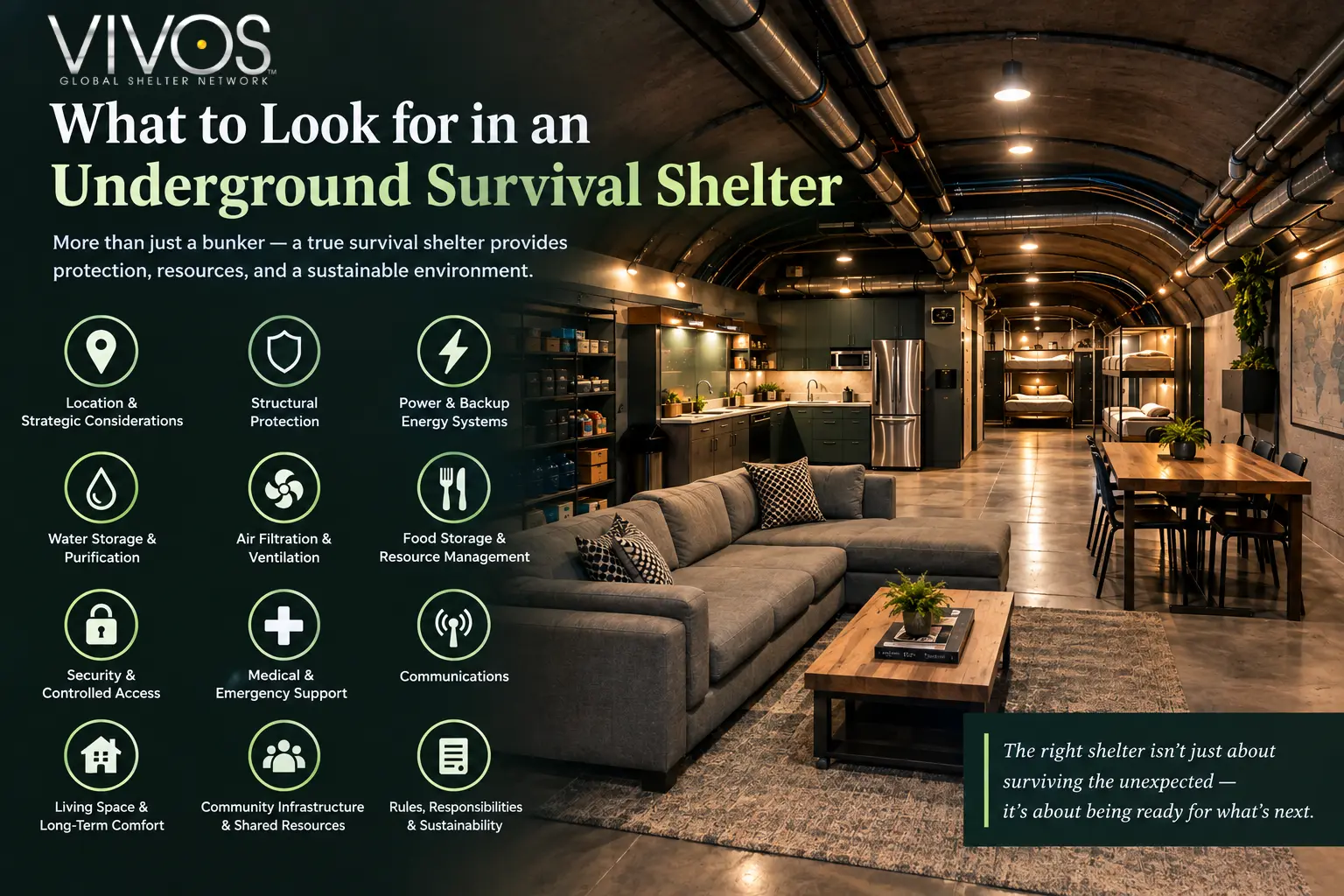
When considering long-term emergency preparedness, choosing an underground survival shelter is a decision that requires more than looking at the size of a bunker or the strength of its doors.
A shelter intended for extended occupancy needs to support more than basic protection. Location, structural design, power, water, air quality, food storage, security, communications, living space, and community infrastructure can all play an important role in determining whether a facility is suitable for long-term preparedness.
No shelter can eliminate every possible risk, and different facilities are designed for different purposes. The right approach is to understand what a shelter provides, how its systems work, and what responsibilities remain with its members.
Here are some of the key factors to consider when evaluating an underground survival shelter.
1. Location and Strategic Considerations
The location of an underground shelter is one of the first factors to evaluate.
A suitable location can influence accessibility, surrounding population density, climate, geography, natural hazards, and distance from major population centers or other potential risk areas.
When researching a shelter, consider:
- Geographic location
- Accessibility during emergencies
- Local climate and weather conditions
- Surrounding population density
- Potential natural hazards
- Distance from major cities
- Availability of transportation routes
- The site’s historical or existing infrastructure
Location alone does not determine how well a shelter will perform. It should be considered together with the facility’s construction, infrastructure, emergency procedures, and intended use.
2. Structural Protection
The primary purpose of an underground shelter is to provide a protected environment during certain emergencies.
For this reason, prospective members should understand how the facility was constructed and what type of structure they are entering.
Important questions include:
- How was the facility originally constructed?
- How far underground is it?
- What materials and structural systems are used?
- Was the structure purpose-built or adapted from an existing facility?
- What types of hazards was the structure designed to address?
- How are entrances and access points protected?
Existing military or hardened infrastructure can offer characteristics that differ significantly from those of a conventional residential basement or purpose-built above-ground structure.
3. Power and Backup Energy Systems
Modern life depends on electricity for lighting, refrigeration, communications, water systems, climate control, medical equipment, and many other essential functions.
An underground survival shelter should therefore have a clearly defined strategy for maintaining essential power if external electricity becomes unavailable.
Depending on the facility, this may involve:
- Independent power generation
- Backup generators
- Battery or energy-storage systems
- Fuel reserves
- Electrical distribution systems
- Backup systems for critical equipment
When evaluating a shelter, ask how long essential systems are designed to operate without normal grid power and what procedures are in place for conserving energy during an extended emergency.
4. Water Storage and Purification
Water is one of the most important requirements for long-term occupancy.
A shelter should have a clear plan for obtaining, storing, treating, and distributing water.
Consider whether the facility includes:
- Water storage
- Water purification
- Water treatment
- Distribution systems
- Backup water resources
- Wastewater management
It is also important to understand whether water resources are shared among residents and how consumption is managed during an extended stay.
Water capacity should always be considered in relation to the number of occupants and the expected duration of sheltering.
5. Air Filtration and Ventilation
Fresh, breathable air is essential in any enclosed underground environment.
A long-term shelter therefore needs ventilation and air-management systems designed around its intended occupancy and operating conditions.
Depending on the facility, these systems may include:
- Mechanical ventilation
- Air filtration
- Air circulation
- Environmental controls
- Backup ventilation systems
- Protected air-intake systems
Prospective members should understand what air-management systems are available and how they are maintained.
This is particularly important because underground living is fundamentally different from simply storing emergency supplies in a basement.
6. Food Storage and Resource Management
A long-term survival shelter needs more than a few days of emergency food.
Food planning may involve:
- Long-term food storage
- Refrigeration or preservation
- Food preparation areas
- Inventory management
- Cooking facilities
- Resource allocation
- Waste management
Community shelters can also approach food management collectively, allowing resources and responsibilities to be organized across multiple households.
However, members should understand exactly what is included by the facility and what they are expected to provide themselves.
7. Security and Controlled Access
Security can become an important consideration during prolonged emergencies, particularly when access to essential resources or outside infrastructure is disrupted.
A shelter may incorporate:
- Reinforced entrances
- Controlled access points
- Security systems
- Monitoring
- Emergency procedures
- Designated entry and exit protocols
The exact measures vary between facilities.
Rather than assuming that an underground location automatically provides security, prospective members should ask specific questions about access control, emergency procedures, community rules, and security responsibilities.
8. Medical and Emergency Support
Medical needs do not disappear during an emergency.
A long-term shelter should have a plan for handling injuries, illness, medications, and other medical situations.
Depending on the facility, this could include:
- Medical areas
- First-aid resources
- Medical supplies
- Trained residents
- Emergency procedures
- Communications with outside medical services
It is also important for individuals to understand what personal medications, medical equipment, and supplies they are responsible for bringing.
9. Communications
Communication can become especially important when normal infrastructure is disrupted.
A shelter may need systems that allow residents to communicate internally and, where possible, maintain contact with the outside world.
Potential systems include:
- Internal communication networks
- Radio systems
- Emergency communications
- Internet connectivity
- External communication equipment
Ask what communication capabilities are available, what happens if external networks fail, and who is responsible for operating the systems.
10. Living Space and Long-Term Comfort
An underground shelter designed for a few hours or days is very different from one intended for extended occupancy.
Long-term living requires consideration of:
- Sleeping areas
- Bathrooms
- Hygiene facilities
- Food preparation
- Dining areas
- Storage
- Recreation
- Common spaces
- Climate control
Comfort may sound secondary during an emergency, but extended sheltering can make living conditions an important part of resilience.
A facility that supports basic routines, privacy where possible, recreation, and social interaction can provide a very different experience from a simple emergency bunker.
For more on this topic, see What Is Life Like Inside an Underground Survival Community?
11. Community Infrastructure and Shared Resources
One of the biggest differences between a private bunker and a large underground survival community is the role of shared infrastructure.
A community can bring together:
- Shared living areas
- Common utilities
- Maintenance resources
- Food systems
- Security procedures
- Medical resources
- Communications
- People with different professional skills
Doctors, engineers, technicians, mechanics, agricultural specialists, communications professionals, and other skilled individuals can all contribute to the community’s ability to operate during a prolonged emergency.
This is one reason some people choose a community-based preparedness model rather than preparing entirely on their own.
You can learn more in Why People Join Underground Survival Communities.
12. Community Rules and Responsibilities
An underground community is not simply a building. It is a shared environment.
Before joining, prospective members should understand:
- Community rules
- Member responsibilities
- Occupancy policies
- Resource-sharing arrangements
- Maintenance responsibilities
- Emergency procedures
- Access policies
- Decision-making processes
These details can have a significant impact on the experience of living within a shared shelter.
Understanding the rules before committing helps ensure that expectations are clear on both sides.
13. Capacity and Long-Term Sustainability
A shelter’s capacity should be considered in relation to its infrastructure.
A facility supporting dozens or hundreds of people requires systems capable of supporting that population.
When evaluating a shelter, consider:
- Maximum occupancy
- Water capacity
- Food resources
- Power capacity
- Air-management systems
- Waste-management systems
- Living space
- Common areas
- Maintenance requirements
The larger the community, the more important organized resource management becomes.
14. What Does the Shelter Actually Provide?
Marketing materials can make different shelters sound similar, even when their infrastructure and intended use are very different.
Before making a decision, create a clear checklist of what is included.
Ask:
What does the membership provide?
What must members bring themselves?
How long is the facility designed for occupancy?
What happens during an extended emergency?
Who maintains the infrastructure?
What are the ongoing costs?
What are the community rules?
These questions can help turn general interest into an informed evaluation.
How Terra Vivos Approaches Underground Survival Shelters
Terra Vivos focuses on large-scale underground survival communities designed around protection, infrastructure, preparedness, and community resilience.
Its shelter options include different types of facilities intended for individuals, families, and larger groups.
Vivos xPoint
Vivos xPoint is located near Edgemont, South Dakota, and consists of hundreds of hardened military-built bunkers developed into a large underground survival community.
The existing structures provide a distinctive foundation for a community-based preparedness environment.
Vivos Europa One
Vivos Europa One is located within a former Cold War military facility in Germany and is designed as a large-scale underground survival complex.
Its extensive underground infrastructure provides a different model from an individual private bunker.
Vivos Indiana
Vivos Indiana is another Terra Vivos community-based shelter designed around long-term preparedness and shared resources.
Each facility has its own characteristics, so prospective members should review the specific details, availability, requirements, and terms of the shelter they are considering.
Underground Survival Shelter Checklist
Before choosing a shelter, consider these key categories:
| Category | What to Evaluate |
| Location | Geography, accessibility, surrounding area, potential hazards |
| Structure | Construction, reinforcement, underground depth, entrances |
| Power | Primary and backup power systems |
| Water | Storage, purification, treatment, distribution |
| Air | Ventilation, filtration, air intake, backup systems |
| Food | Storage, preparation, supplies, resource management |
| Security | Controlled access, monitoring, emergency procedures |
| Medical | Medical resources, supplies, emergency protocols |
| Communications | Internal and external communication systems |
| Living Space | Sleeping, hygiene, dining, recreation, common areas |
| Community | Skills, responsibilities, rules, shared resources |
| Costs | Membership, ongoing expenses, personal supplies |
| Capacity | Occupancy and infrastructure capacity |
| Emergency Planning | Procedures for prolonged sheltering and unexpected events |
Why Research Matters Before Choosing a Shelter
An underground survival shelter is a significant preparedness decision.
The most important step is not simply finding the deepest bunker or the largest facility. It is understanding how the entire system works.
Look beyond the structure itself and evaluate the infrastructure, location, resources, community organization, emergency procedures, and long-term living environment.
A shelter should be evaluated based on its documented capabilities and how those capabilities match your own preparedness needs.
Explore Terra Vivos Underground Survival Communities
If you are researching long-term emergency preparedness, explore Terra Vivos’ underground survival communities and available shelter options.
- Vivos xPoint
- Vivos Europa One
- Vivos Indiana
- Available Shelters
- Membership Application
- Contact Terra Vivos
Final Thoughts
Choosing an underground survival shelter requires looking at much more than concrete walls and reinforced doors.
A long-term shelter is a complete system.
Location, structural protection, power, water, air filtration, food, security, communications, medical resources, living spaces, and community organization all contribute to how a facility can function during an extended emergency.
No shelter can guarantee protection from every possible event. The goal of preparedness is to understand the available options, identify the capabilities that matter to you, and make an informed decision before an emergency occurs.
For people planning beyond short-term emergency supplies, an underground survival community can provide an approach built around shared infrastructure, resources, skills, and long-term preparedness.
Frequently Asked Questions
What should I look for in an underground survival shelter?
Consider the shelter’s location, structural design, power, water, air filtration, food resources, security, communications, medical support, living facilities, community rules, and long-term sustainability.
How important is the location of an underground shelter?
Location can influence accessibility, geography, climate, surrounding population density, and exposure to certain natural or human-caused hazards. It should be evaluated together with the facility’s infrastructure and design.
How do underground shelters provide power?
Depending on the facility, underground shelters may use independent power generation, backup generators, energy storage, or other systems designed to support essential operations when grid electricity is unavailable.
How do underground survival shelters manage water?
Facilities may use water storage, purification, treatment, and distribution systems. Prospective members should understand the shelter’s capacity and how water resources are managed during extended occupancy.
What is the difference between a private bunker and a survival community?
A private bunker generally emphasizes individual or family privacy and control, while a survival community incorporates shared infrastructure, resources, responsibilities, and community facilities.
Can families live in underground survival communities?
Yes, some underground survival communities are designed to accommodate individuals and families. Living arrangements, occupancy limits, and community requirements vary by facility.
How can I evaluate an underground shelter before joining?
Review the facility’s documented infrastructure, location, occupancy, costs, rules, emergency procedures, included resources, and member responsibilities. Ask specific questions rather than relying only on general marketing claims.


